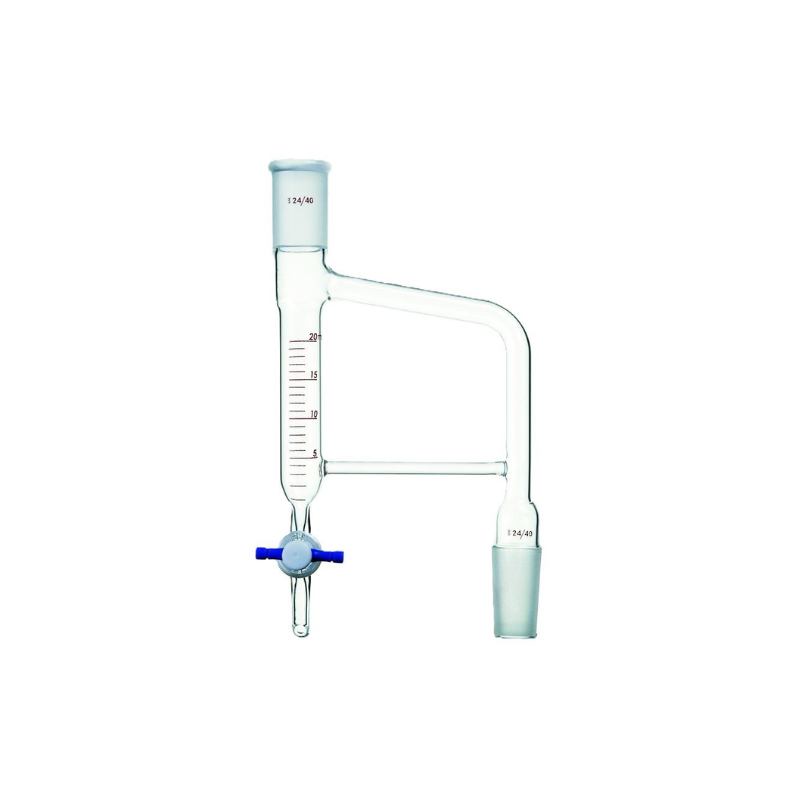
Dean Stark Distillation Receiver
CH-D451414
Vendor: SmartLabs
Suited For:
Country of Origin:
Low stock! Only 2 left
Regular price
R 500.00
Sale price
R 500.00
Regular price
Unit price
per
Tax included.
Shipping calculated at checkout.
Couldn't load pickup availability
- Fast Nationwide Delivery
- 100% Quality Guaranteed
- Reliable & Secure Payments
Have a question about this product?
Send us a message and we'll get back to you.
Dean Stark Distillation Receiver (also known as a Dean-Stark Trap) is a specialized piece of laboratory glassware used to continuously remove water or other liquid byproducts from a reaction mixture during reflux. This is commonly used in azeotropic distillation to drive chemical equilibria toward the product side, such as in esterification reactions.
Core Function & Mechanism
The receiver works by distilling an azeotropic mixture (e.g., toluene and water). Once condensed, the two immiscible liquids separate in the trap based on their density:
- Phase Separation: The water (more dense) settles at the bottom of the graduated trap.
- Recycling: The organic solvent (less dense) flows back into the reaction flask once the liquid level reaches the side-arm overflow.
- Monitoring: The graduated scale allows for real-time measurement of the water produced, indicating when the reaction is complete.
Key Components
- Graduated Reservoir: A cylindrical tube used to measure the volume of the collected phase. Common capacities include 5mL, 10mL, and 25mL.
- Stopcock: Usually a PTFE (Teflon) or glass tap at the bottom for easy draining of the collected water.
- Joints: Typically features standard taper ground glass joints, with 24/29 being standard in many regions and 24/40 common in the US.
- Vapour Tube: A side-arm that provides a path for vapours to travel from the boiling flask to the condenser.
Common Applications
- Organic Synthesis: Removing water byproducts in esterification or Schiff base synthesis to increase yield.
- Moisture Determination: Quantitatively measuring the water content in petroleum products, food (like bread or fats), and oils.
- Solvent Drying: Removing traces of water from solvents like toluene through azeotropic distillation.
Comparison: Dean-Stark vs. Clevenger
While similar in appearance, their primary use differs:
- Dean-Stark: Primarily used to remove water as a waste byproduct or for moisture analysis.
- Clevenger: Specifically designed for the extraction of essential oils, often featuring a return arm to recirculate the water (hydrosol) while trapping the oil.
Delivery
Delivery
Our Promise
Our Promise