Leaf Structure
BM0048
Vendor: EISCO
Couldn't load pickup availability
- Fast Nationwide Delivery
- 100% Quality Guaranteed
- Reliable & Secure Payments
Have a question about this product?
Send us a message and we'll get back to you.
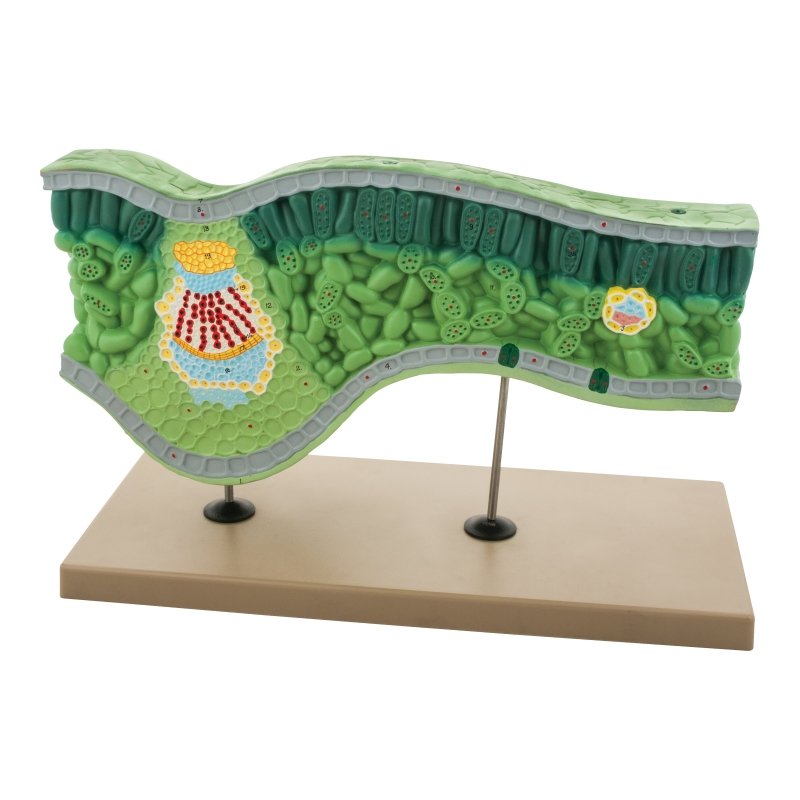
A detailed leaf structure model, mounted on a stand and numbered with an English key card, would be a helpful visual aid for studying leaf anatomy. This type of model typically depicts the internal structure of a leaf, including various tissues like the epidermis, mesophyll (palisade and spongy), vascular bundles (xylem and phloem), and stomata. The numbering and key card allow for easy identification of each part of the leaf's structure.
Models like this are used in educational settings to teach students about the structure and function of leaves, which are essential for photosynthesis and plant survival.
Size 45 x 19 x 30 cm approx. Weight 2.1 kg approx.
Epidermis: The outer layer of cells, often with a waxy cuticle on top to prevent water loss.
Mesophyll: The tissue in the middle of the leaf, divided into palisade mesophyll (columnar cells, often packed with chloroplasts for photosynthesis) and spongy mesophyll (loosely arranged cells with air spaces).
Vascular Bundles: These contain xylem (which transports water and minerals) and phloem (which transports sugars).
Stomata: Pores, usually on the underside of the leaf, that allow for gas exchange (carbon dioxide in, oxygen and water vapor out).
Cuticle: A protective layer on the outer surface of the leaf.
Bundle Sheath: Cells surrounding the vascular bundles.
Clear Identification: A numbered key card is provided, enabling users to easily identify and learn the names of different anatomical structures.
Educational Use: The model is designed for use in medical anatomy and physiology courses, patient education, and in medical offices where visualization of the female pelvis is needed.
Quality Construction: It is crafted by subject matter experts and features vibrant, hand-painted details with eco-friendly paint.