Model Animal Cell Division Meiosis - Mini
ZM16083
Vendor: EISCO
Couldn't load pickup availability
- Fast Nationwide Delivery
- 100% Quality Guaranteed
- Reliable & Secure Payments
Have a question about this product?
Send us a message and we'll get back to you.
A Set of 12 models illustrating the detailed stages of meiotic cell division, specifically designed to highlight the cellular structures as seen under a microscope, is a valuable educational resource. These 12 stages ensure that each resulting haploid daughter cell receives a unique combination of chromosomes from the parent cell.These models are beautifully colored to enhance the visibility of the detailed structures and are mounted on a base for easy display and study.
Size 42 x 30 x 5 cm approx. Weight 940 g approx.
Detailed Stages: The set includes models for each of the key stages in meiosis, providing a comprehensive visual guide to the process.
Colored for Detail: The vibrant colors used in the models help distinguish different cellular components, making it easier to understand the intricate details of meiosis.
Mounted on a Base: The models are mounted on a base, which provides stability and makes them convenient for classroom demonstrations and individual study.
Educational Value: These models serve as an excellent tool for teaching and learning about cell division, particularly the complex process of meiosis.
Leptotene: is the first stage of prophase I in meiosis, characterized by the condensation of chromosomes into thread-like structures within the nucleus. During this stage, homologous chromosomes begin to pair up, although they are not yet fully synapsed (associated).
Zygotene: In the zygotene stage, homologous chromosomes (one from mother and one from father) come together and pair. The process of the pairing of homologous chromosomes is known as synapsis. The process of synapsis is very specific and exact.
Pachytene: is a stage within prophase I of meiosis, a type of cell division that reduces the chromosome number by half. During pachytene, homologous chromosomes are fully paired and synapsed, meaning they are tightly connected along their lengths by the synaptonemal complex. This stage is also characterized by crossing over, where genetic material is exchanged between non-sister chromatids of homologous chromosomes.
Diplotene: the fourth stage of the prophase of meiosis, following pachytene, during which the paired chromosomes begin to separate into two pairs of chromatids.
Diakinesis: the fifth and last stage of the prophase of meiosis, following diplotene, when the separation of homologous chromosomes is complete and crossing over has occurred.During diakinesis, the chromosomes are in their most robust state. In a bivalent, there is still at least one chiasm connecting the homologous chromosomes. As a result, the centrosome moves to the equator, the nucleolus dissolves, the nuclear envelope collapses, and the mitotic spindles move.
Prophase I:Chromosomes condense, homologous chromosomes pair up (synapsis), and crossing over (exchange of genetic material) occurs. Prophase I is further divided into five substages: leptotene, zygotene, pachytene, diplotene, and diakinesis.
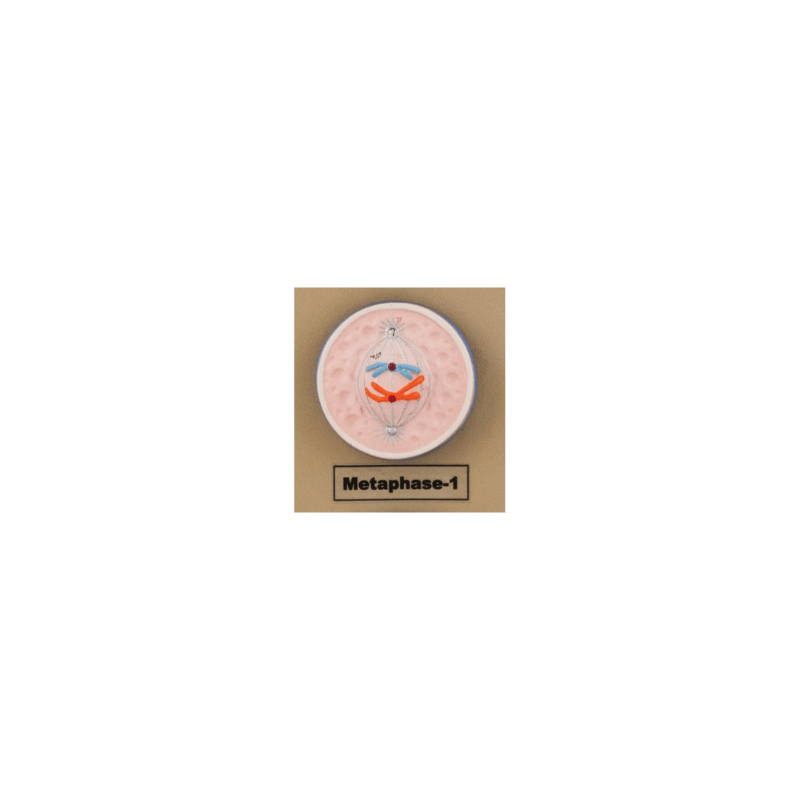
Metaphase I:Homologous chromosome pairs line up at the cell's equator (metaphase plate).
Anaphase I: Homologous chromosomes are separated and pulled to opposite poles of the cell.
Telophase I: Chromosomes arrive at the poles, nuclear membranes may reform, and the cell divides (cytokinesis I).
Meiosis II
Prophase II: Chromosomes condense again if they decondensed in Telophase I, nuclear envelopes break down, and new spindle fibers form.
Prometaphase II: Spindle fibers attach to the chromosomes.
Metaphase II: Chromosomes line up individually at the equator of each cell.
Anaphase II: Sister chromatids of each chromosome are separated and pulled to opposite poles.
Telophase II: Chromosomes arrive at the poles, nuclear envelopes reform, and the cell divides (cytokinesis II).