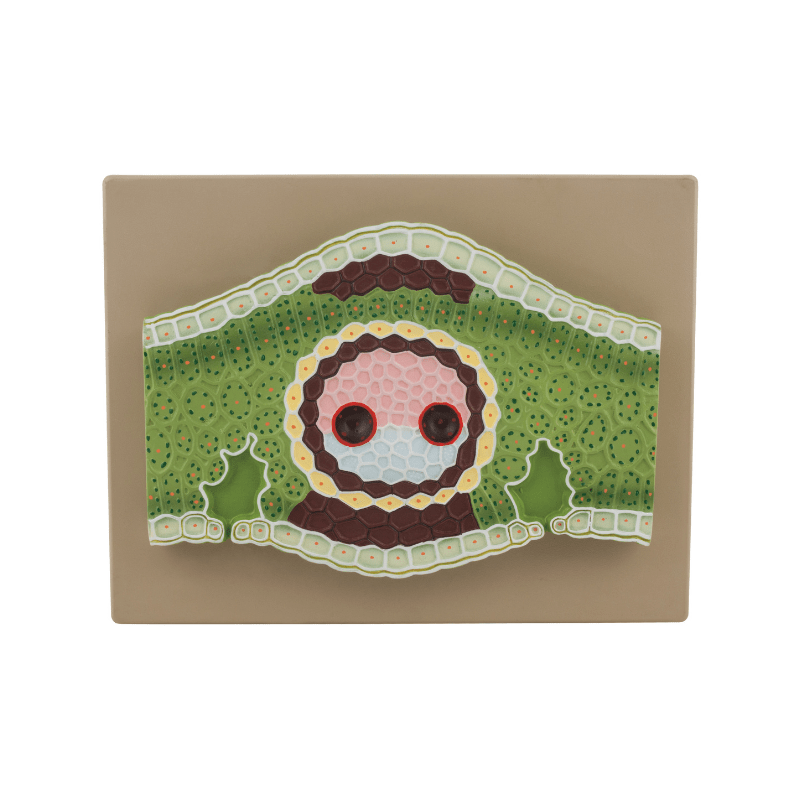
Monocot Leaf Model, Vertical Section - 300x Magnified
BM0022
Vendor: EISCO
Couldn't load pickup availability
- Fast Nationwide Delivery
- 100% Quality Guaranteed
- Reliable & Secure Payments
Have a question about this product?
Send us a message and we'll get back to you.
This is a detailed model of a monocot leaf, enlarged 300 times its actual size, showcasing its vertical section. Key features highlighted include the cuticle, upper and lower epidermis, palisade and spongy parenchyma, bundle sheath, xylem, phloem, intercellular spaces, and stomata. The model is mounted on a base and comes with a key card for identification of the structures.
A leaf's internal structure includes a cuticle, upper and lower epidermis, palisade and spongy parenchyma, bundle sheath, xylem, phloem, intercellular spaces, and stomata, each with a specific function in photosynthesis and gas exchange. The cuticle is a waxy layer on the epidermis that reduces water loss. The upper and lower epidermis form a protective layer, with the lower epidermis containing stomata for gas exchange. The palisade parenchyma (also known as palisade mesophyll) is where most photosynthesis occurs, while the spongy parenchyma (also known as spongy mesophyll) contains air spaces for gas circulation. Xylem and phloem, part of the vascular bundle, transport water and sugars, respectively. The bundle sheath surrounds the vascular bundle. Intercellular spaces in the spongy mesophyll facilitate gas movement.
Vertical Section: In biology, a vertical section, also known as a longitudinal section, refers to a cut or plane that divides a structure along its longest axis, separating it into left and right (or anterior and posterior) portions. It's a type of sectioning used to reveal the internal structure of biological specimens.
Cuticle: A protective, waxy layer on the outer surface of the leaf, primarily to prevent water loss.
Epidermis (Upper and Lower): A single layer of cells covering the leaf, providing protection. The lower epidermis contains stomata.
Mesophyll:
The tissue between the upper and lower epidermis, consisting of palisade and spongy parenchyma.
- Palisade Parenchyma: Columnar cells, tightly packed and rich in chloroplasts, where most photosynthesis takes place.
- Spongy Parenchyma: Loosely arranged cells with air spaces, facilitating gas exchange (CO2 and O2) within the leaf.
Vascular Bundle: Contains xylem and phloem, responsible for water and nutrient transport, respectively.
Bundle Sheath: A layer of cells surrounding the vascular bundle, providing support and regulating movement of substances.
Intercellular Spaces: Air spaces within the spongy mesophyll, allowing for gas circulation.
Stomata: Pores in the epidermis (usually the lower epidermis) that allow for gas exchange (CO2 uptake and O2 release) and transpiration (water vapor release).
Clear Identification: A numbered key card is provided, enabling users to easily identify and learn the names of different anatomical structures.
Quality Construction: It is crafted by subject matter experts and features vibrant, hand-painted details with eco-friendly paint.