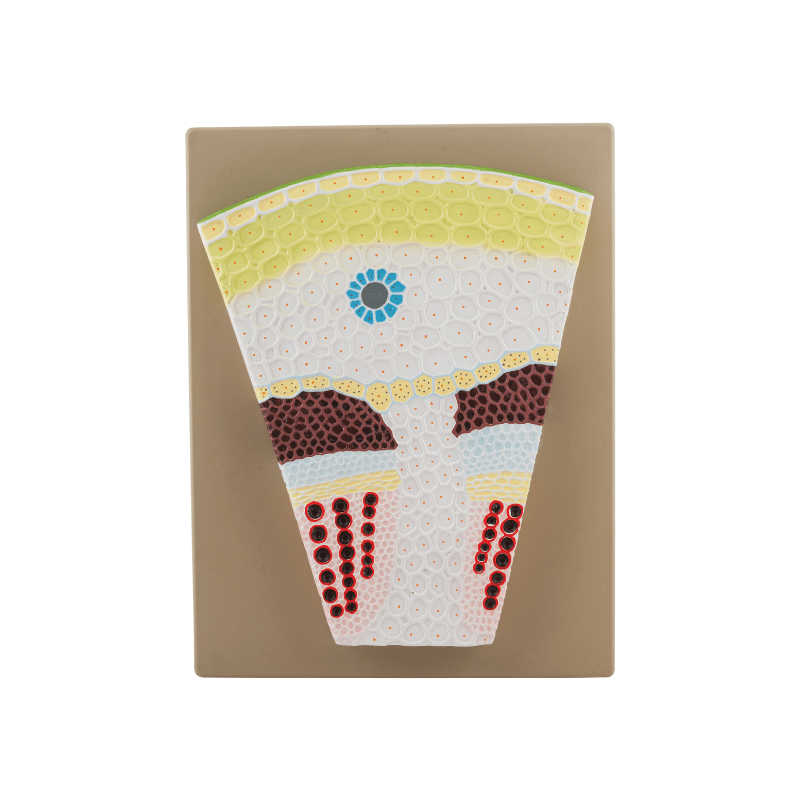
Premium Dicot Stem Model, on Base - Transverse Section, Greatly Magnified
BM0012
Vendor: EISCO
Couldn't load pickup availability
- Fast Nationwide Delivery
- 100% Quality Guaranteed
- Reliable & Secure Payments
Have a question about this product?
Send us a message and we'll get back to you.
A Premium Dicot Stem Model, typically used for educational purposes, is a three-dimensional, greatly magnified, and vibrantly colored representation of a dicot stem's transverse (cross) section. It is mounted on a sturdy base for display and study, and includes a key to identify anatomical features. The model allows for detailed examination of the stem's internal structure, including the arrangement of vascular bundles, the presence of cambium, and other key tissues.
A transverse section is a slice or cut made through an object or structure perpendicular to its long axis or main plane. It's essentially a cross-section, dividing the object into upper and lower portions. In biological contexts, it's a common technique for examining internal structures of plant and animal tissues under a microscope. The key characteristic of a transverse section is that it's cut at a right angle to the object's length or main direction.
Cross-Section: This term is often used interchangeably with transverse section, both referring to a slice across the object.
Dicot Stem: A dicot stem, found in flowering plants with two seed leaves (dicotyledons), is characterized by a well-defined structure including epidermis, cortex, vascular bundles, and pith. Vascular bundles are arranged in a ring, and the stem exhibits secondary growth, allowing for increased girth.
Epidermis: The outermost layer, often with a waxy cuticle, protects the stem and prevents water loss.
Cortex: Located beneath the epidermis, the cortex is composed of parenchyma cells and may include collenchyma for support.
Vascular Bundles: Arranged in a ring, these bundles contain xylem (for water transport) and phloem (for food transport), separated by a layer of cambium which allows for secondary growth.
Pith: The central region of the stem, primarily composed of parenchyma cells, which may store nutrients.
Secondary Growth: Dicot stems can increase in diameter due to the activity of the cambium, which produces new xylem and phloem.