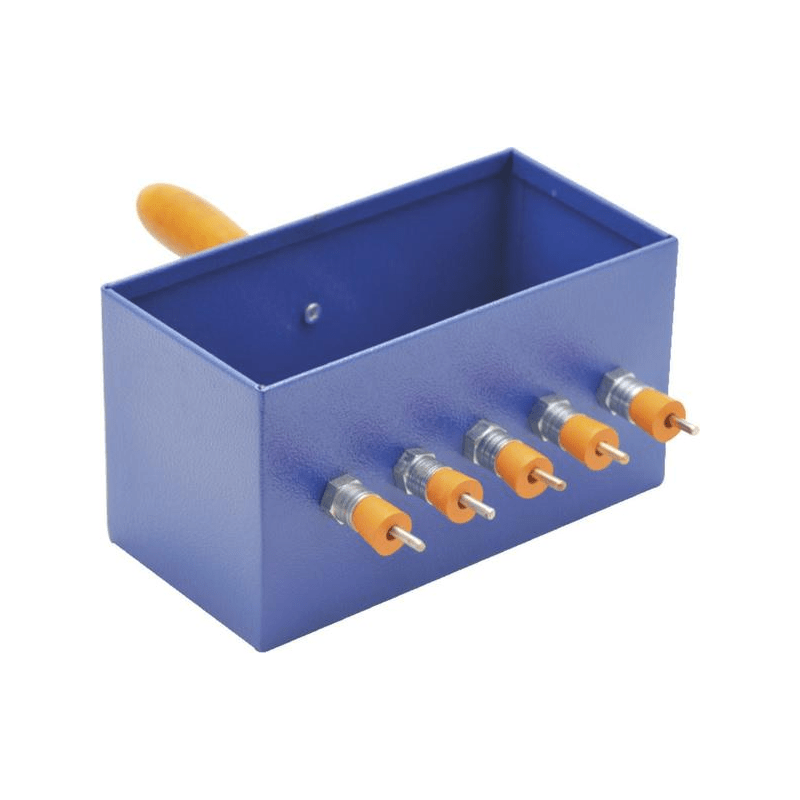
Conductivity Apparatus (Ingen Haussz)
EDU174
Vendor: SmartLabs
Couldn't load pickup availability
- Fast Nationwide Delivery
- 100% Quality Guaranteed
- Reliable & Secure Payments
Have a question about this product?
Send us a message and we'll get back to you.
The Ingen-Hausz Conductivity Apparatus is a classic physics laboratory tool used to demonstrate and compare the thermal conductivity of different metals. It provides a visual representation of how heat travels at varying speeds through various materials. This apparatus is widely used for GCSE and A-Level physics.
Experimental Procedure
The experiment, known as the Ingen-Hausz Method, follows these steps:
- Preparation: Each rod is lightly and evenly coated with paraffin wax.
- Heating: The tank is filled with hot water (or an oil bath for higher temperatures).
- Observation: As heat conducts from the tank into the rods, the wax begins to melt.
- Comparison: Students measure the length of the melted wax on each rod once a steady state is reached.
Scientific Principle
According to the experiment's findings, the thermal conductivity (K) of a material is proportional to the square of the length (L) of the melted wax. This means that a rod where the wax melts twice as far as another has four times the thermal conductivity. For example, wax will melt significantly further along a copper rod than an iron one in the same amount of time, clearly demonstrating copper's superior heat transfer efficiency.