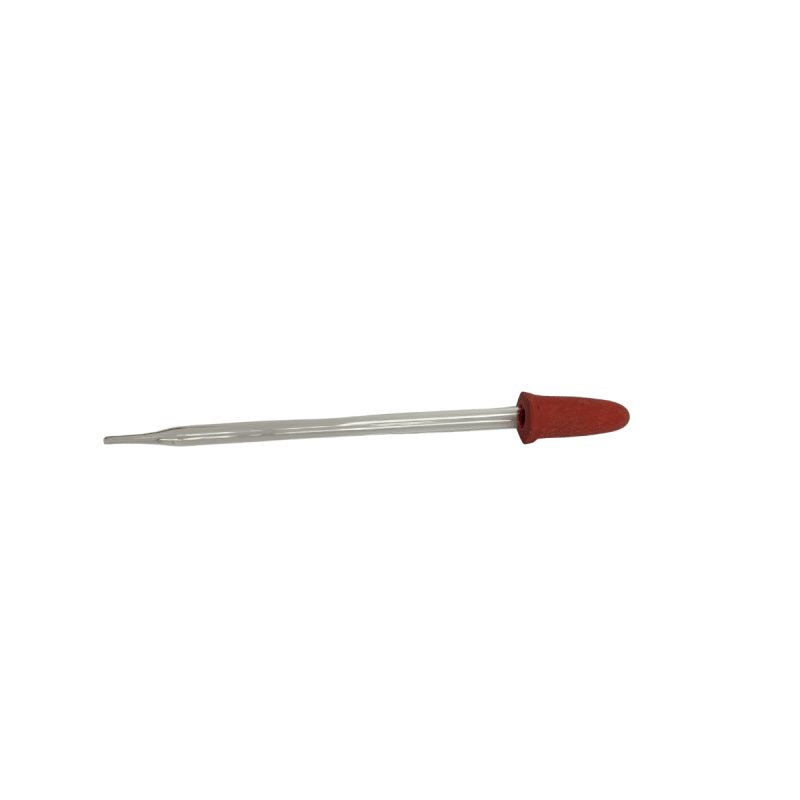
Pipette Dropping Glass - Single 125mm Glass Pipette with Rubber Teat
JN-EDU163-SN
Vendor: JOANLAB
Suited For:
Country of Origin: China
Couldn't load pickup availability
- Fast Nationwide Delivery
- 100% Quality Guaranteed
- Reliable & Secure Payments
Have a question about this product?
Send us a message and we'll get back to you.
This single 125mm glass dropping pipette with a rubber teat is a standard lab tool for transferring liquids drop by drop. It's a narrow glass tube tapered to a fine tip, with a replaceable rubber teat (bulb) on top.
Key Features
- Size: The 125mm length (about 5 inches) is a handy short size for drawing liquid from standard reagent bottles or test tubes.
- Material: The body is borosilicate or soda-lime glass, resistant to most chemicals and easy to sterilise.
- Rubber teat: A flexible bulb that creates the suction to draw up liquid. It can be removed for cleaning.
- Controlled delivery: The tapered tip gives even drops, which matters for qualitative analysis and indicator tests.
Common School Applications
- Adding indicator: Adding drops of phenolphthalein or litmus solution during titrations.
- Micro-chemistry: Mixing small volumes of reactants on a spotting tile.
- Microscopy: Placing a single drop of water or stain on a slide before adding a coverslip.
- Staining: Applying methylene blue or iodine to specimens like onion skin cells.
Care and Maintenance
- Cleaning: To prevent cross-contamination, separate the glass tube and rubber teat and wash both thoroughly after each use.
- Storage: Don't store the pipette with liquid in the teat, as chemicals can break down the rubber over time.
- Safety: Check the glass tip for chips or cracks before use, to avoid injury or uneven drops.
Specifications
- Material: Clear glass and rubber
- Size: 125mm
- Volume: About 1.5ml to 2.0ml
- Teat: Rubber
- Printing: None
- Product of China
How many drops per ml? A standard 125mm glass dropping pipette gives about 20 drops per millilitre. That's a common rule of thumb in science labs, but the exact number depends on:
- Viscosity: Thicker liquids (like oils or glycerine) form bigger, fewer drops.
- Surface tension: Soapy water or alcohol form much smaller, more frequent drops than pure water.
- Tip diameter: A chipped or wider tip gives bigger drops, so fewer per ml.
Tip: If you need precision, a good introductory exercise is to have students calibrate their own pipettes by counting how many drops of water it takes to reach the 1ml or 5ml mark in a measuring cylinder.
Delivery
Delivery
Our Promise
Our Promise