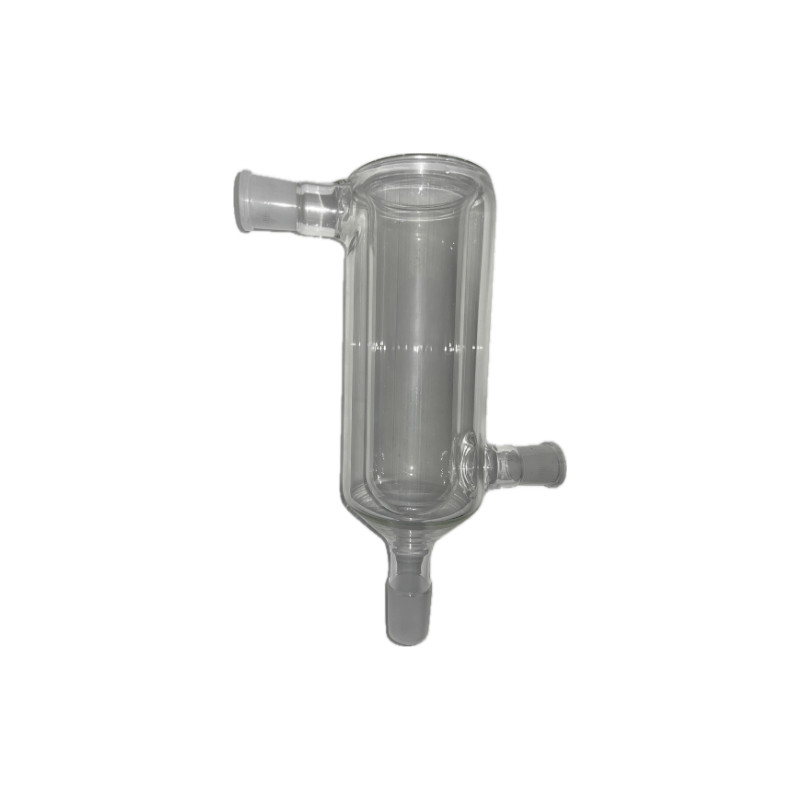
Dry Ice Cold Trap 180mm - B24 Vacuum Socket
LS-CT180BS24-B29
Vendor: SmartLabs
Suited For:
Country of Origin:
Couldn't load pickup availability
- Fast Nationwide Delivery
- 100% Quality Guaranteed
- Reliable & Secure Payments
Have a question about this product?
Send us a message and we'll get back to you.
Dry Ice Cold Trap is a piece of laboratory glassware designed to capture and condense vapors during scientific experiments, especially those involving distillation, solvent recovery, or vacuum processes. It functions by cooling the vapors as they pass through the trap, causing them to condense into a liquid or solid form, preventing unwanted vapors from entering other parts of the system or the vacuum. Cold traps are particularly important in distillation and filtration setups where it is necessary to isolate or recover vapors, liquids, or gases.
Key Features
Borosilicate Glass: The cold trap is made from borosilicate glass (such as Pyrex), a type of glass known for its chemical resistance, thermal stability, and durability. Borosilicate glass can withstand high temperatures and is resistant to a wide range of chemicals, making it ideal for laboratory environments.
Transparent: Glass allows for easy visual monitoring of the contents inside the cold trap. This is useful for observing the condensation process or checking for any blockages or overflow
Shape: Double-walled (Jacket) straight tube design allowing for improved heating and cooling control during the condensation process. The double-walled design increases the surface area for efficient cool and condense.
Double-Walled Design: Features a double-walled construction, where the outer chamber is cooled by the refrigerant (e.g., dry ice) and the inner chamber is where the vapors condense. This type of design improves the efficiency of the condensation process and helps maintain low temperatures.
Vacuum Inlet and Outlet Ports: These ports are usually equipped with ground glass joints (24/29) or 10mm compatible tubulation sockets. The ground glass joints allow for multiple cold traps to be connected to each other with a glass double cone shank, whereas the tubulation socket can be connected from the vacuum to the tubulation socket using vacuum tubing.
Condensed Outlet Ports: The condensed outlet port is aground glass joint (24/29 or 29/32) that connects the condenser to a collection flask of you choosing. The collection flask can be disconnected to decant the content.
Vapor Path: Vapors flow through the trap and come into contact with the cold surface of the trap, where they lose heat and condense into a liquid or solid form, which can then be collected in the trap.
Cooling Agent: The trap is cooled using an external cooling agent. Common cooling agents include dry ice (solid CO₂), liquid nitrogen, or coolant fluids that flow through the inner chamber or double-walled structure of the trap to lower its temperature significantly.
Applications: Distillation, Solvent Recovery, Chemical Reactions as well as Vacuum Systems.
Specifications:
- Flask Joint: 24/29 or 29/32 (see option selected)
- Vacuum Inlet and Outlet Ports: B24 gound glass socket
- Cooling Liquid Tube: 10mm I.D. Glass Barb
- Condenser Length: 180mm (aprox.)
- Condenser I.D: 50mm (aprox.)
- Condenser O.D: 90mm (aprox.)
- Glass: 3.3 Borosilicate Glass
Delivery
Delivery
Our Promise
Our Promise