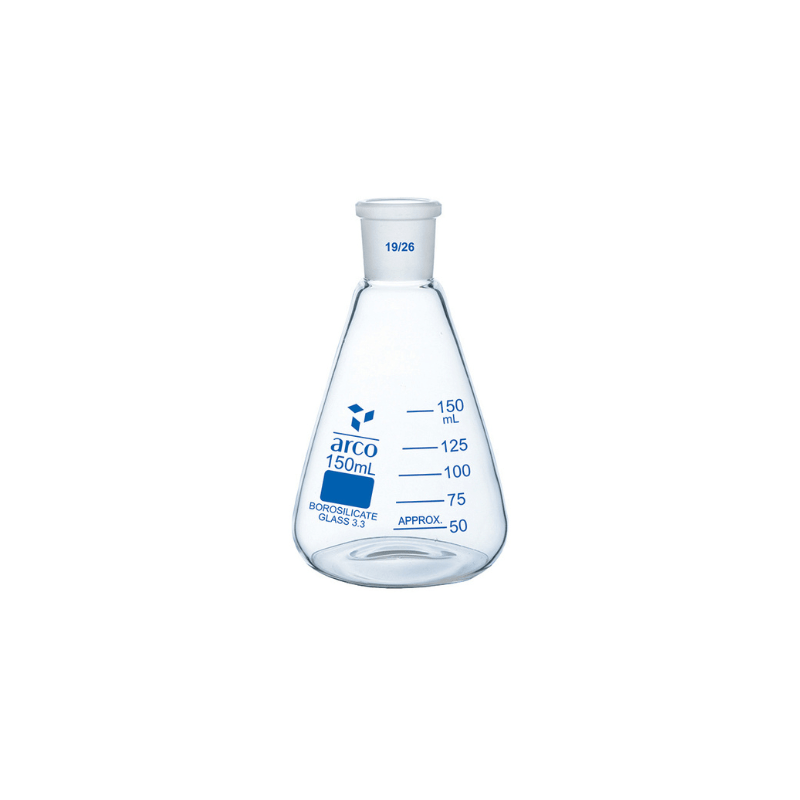
Erlenmeyer Flasks with Socket Neck
IN-2064170-26
Vendor: SmartLabs
Couldn't load pickup availability
- Fast Nationwide Delivery
- 100% Quality Guaranteed
- Reliable & Secure Payments
Have a question about this product?
Send us a message and we'll get back to you.
An Erlenmeyer flask with a socket neck, also known as a conical flask with a ground glass joint, is a laboratory vessel with a flat base, a conical body, and a short neck featuring a ground glass female joint. This feature allows for the quick and easy connection of other pieces of lab apparatus, such as condensers or addition funnels, without the need for a rubber stopper.
These flasks are made from borosilicate glass for excellent resistance to chemicals and thermal shock, and they are available from many laboratory supply brands.
The conical shape of an Erlenmeyer (or conical) flask makes it suitable for mixing liquids primarily because it allows for vigorous swirling without the risk of spillage. The design combines a wide, stable base with a narrow neck, which provides several key advantages: Spill Prevention, Reduced Evaporation/Contamination, Ease of Handling. Effective Agitation and Stability.
Features
Material: Borosilicate glass (Borosilicate 3.3) is the standard for laboratory glassware, offering high resistance to chemicals and thermal shock. For more robust heating applications, look for heavy-walled flasks.
Joint Size: The socket (or ground glass joint) allows for a secure, leak-proof connection to other equipment. Joint sizes are standardized (e.g., NS19/23, NS24/29, NS 29/32)
Capacity: Flasks are available in a wide range of volumes, typically from 50 mL up to 5000 mL.
Graduations: Many flasks include volume indicator lines for approximate measurements. However, for precise volume measurements, a volumetric flask should be used instead.
Writing Surface: Some flasks have a special matte finish or enamel marking area where they can be easily labeled with a pencil.
Uniform Wall Thickness: distribution heat evenly making the flasks ideal for heating.
Spill Prevention: The slanted sides guide the liquid back down to the bottom of the flask as it is swirled, preventing it from splashing out over the top. This is especially crucial during processes like titrations, where a reagent (titrant) is added drop by drop from a burette and the flask must be continuously swirled to ensure thorough mixing and observation of the endpoint.
Reduced Evaporation/Contamination: The narrow neck minimizes the surface area exposed to the air. This reduces solvent loss through evaporation and provides a barrier against airborne contaminants. It also allows for the neck to be easily sealed with a stopper or a cap, which is not as simple with a beaker.
Ease of Handling: The neck offers a convenient handhold for swirling the flask manually.
Effective Agitation: The shape facilitates a controlled, swirling motion (vortex) that ensures all components are thoroughly distributed and mixed. When used on an orbital shaker for applications like cell cultures, this shape, sometimes enhanced with internal baffles, promotes chaotic mixing and aeration.
Stability: The wide, flat base ensures the flask remains stable on a lab bench or hot plate, further reducing the risk of accidental tipping during an experiment.
Specification
- Capacity: Available from 500mL up to 2000mL
- Shape: Conical form makes them suitable for mixing liquids
- Material: Borosilicate 3.3 Glass Heat Resistant, Low Expansion
- Print: Blue
- Compliance with DIN/ISO 4797 and ASTM E-438 standards
- Product of India
- Brand: ARCO