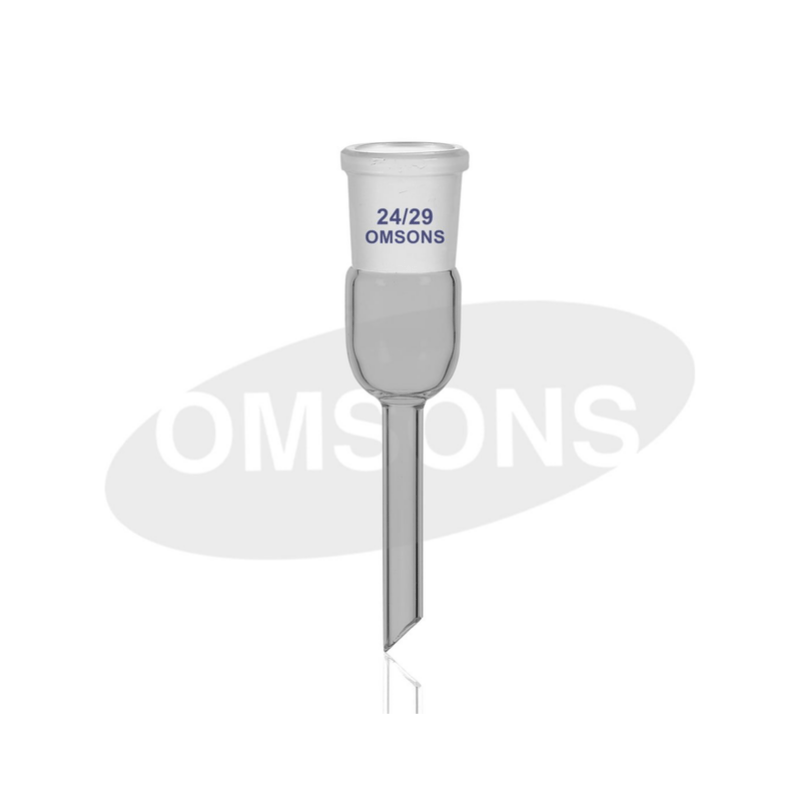
Adapters Receiver - Straight Stem
OM-1009-04
Vendor: OMSONS
Suited For: Lab and Research
Country of Origin: India
This warranty does not cover: breakage caused by thermal shock (rapid heating or cooling); physical or mechanical damage, including drops, impacts, chips, and cracks from handling; damage from use outside the glassware's rated temperature, pressure, or chemical compatibility; damage from improper cleaning; normal wear such as scratching, staining, or discolouration; or unauthorised repair or modification.
To claim, contact SmartLabs within 30 days of purchase with proof of purchase and a description of the defect.
Couldn't load pickup availability
- Fast Nationwide Delivery
- 100% Quality Guaranteed
- Reliable & Secure Payments
Have a question about this product?
Send us a message and we'll get back to you.
An Adapter Receiver Straight Stem is a laboratory glassware component used in distillation setups to safely and efficiently transfer distillate from a condenser to a receiving flask or other collection vessel. It features a straight, tube-like stem that provides a direct path for the distillate to flow.
Connection: The adapter typically has a ground glass joint on one end for connection to the condenser.
Straight Stem: The "straight stem" refers to the shape of the adapter's outlet, which is a simple, direct tube. This design ensures a smooth and unimpeded flow of the distillate.
Drip Tip: Some adapters have a drip tip or a delivery stem to ensure that the liquid flows smoothly and doesn't splash or drip outside the receiving flask.
NS Joint Connector: Also known as a ground joint connector, is a type of connector used in laboratory glassware to create a secure, airtight, and grease-free seal between two glass pieces. These connectors are commonly used in chemistry and other scientific fields for transferring liquids or gases, particularly in situations where contamination needs to be avoided.
A 19/26 joint connector refers to a ground glass joint with a 19mm outer diameter at the top of the male joint (or inner diameter at the top of the female joint) and a 26mm length of the ground glass taper. This standardized size ensures interchangeability between different pieces of glassware, facilitating the construction of complex setups for experiments.
Materials: Distillation delivery adapters are typically made of borosilicate glass due to its resistance to high temperatures and chemical corrosion.
Specifications
Specifications
Delivery
Delivery
Warranty
Warranty
Our Promise
Our Promise