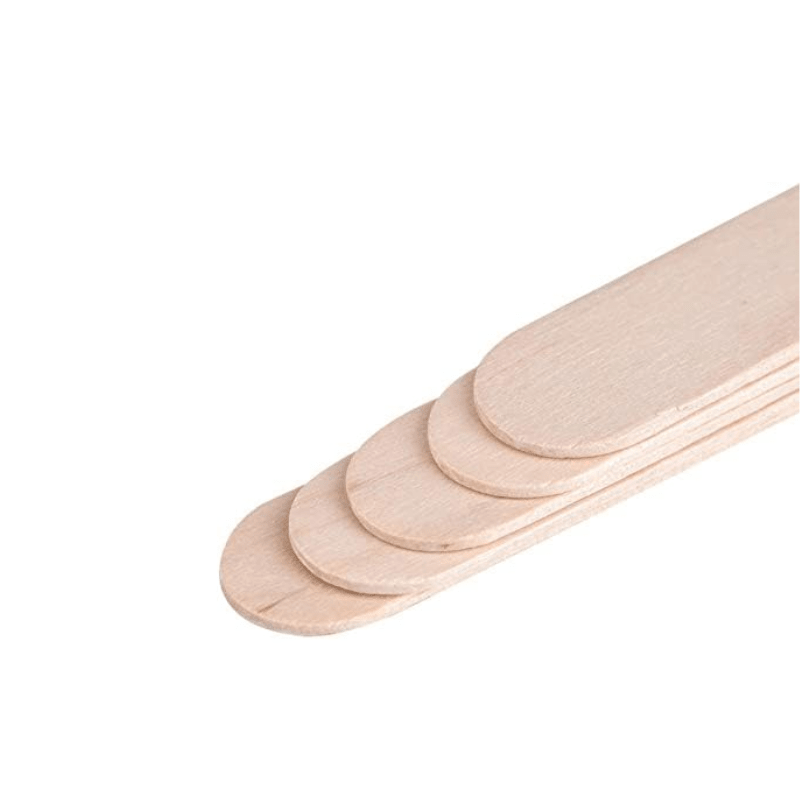
Tongue Depressor - Wood
CNW-TYN400
Vendor: SmartLabs
Couldn't load pickup availability
- Fast Nationwide Delivery
- 100% Quality Guaranteed
- Reliable & Secure Payments
Have a question about this product?
Send us a message and we'll get back to you.
These wooden tongue depressors are disposable 15cm wooden sticks with smooth, rounded ends, made for mouth and throat examinations. They're non-sterile, single-use and non-toxic, and help doctors, nurses and ENT specialists hold down the tongue for a clear view of the throat. They're sold in packs of 100.
Tongue depressors are also widely used as disposable mixing sticks for acrylics and mouldable silicones, and they're a staple in crafts, moulding and casting because they're cheap and strong.
In schools, tongue depressors (often called craft sticks) are popular for experiments because they're a uniform size, low cost and can store elastic potential energy.
Key Features and Uses
- Size: 150mm x 16mm
- Material: Generally made from smooth, splinter-free wood such as northern white birch.
- Safety: Non-toxic and single-use, for hygienic disposal that prevents cross-infection.
- Applications: Used in clinics and hospitals, and also for craft projects, waxing by beauty therapists and by tattooists.
- Please note: They're non-sterile, so don't use them for sterile procedures.
Physics and Energy Experiments
- Stick chain reaction: Weave sticks in a "cobra weave" to store elastic potential energy. When you release the end, the tension turns into kinetic energy and the sticks burst into the air one after another.
- Catapult: Use a stack of sticks as a fulcrum and one stick as a lever arm to launch light objects like pom-poms, showing Newton's laws of motion, force and trajectory.
- Harmonica: Sandwich a wide rubber band and small pieces of straw between two sticks. Blowing through the gap makes the band vibrate, showing how sound waves are made.
Engineering and Structures
- Bridge building: Students design bridges to test load capacity and strength, learning about trusses (triangular supports) and how shapes spread a load.
- Tower challenge: Building the tallest freestanding tower teaches base design, centre of gravity and using materials efficiently.
- Da Vinci bridge: Sticks are assembled into a self-supporting arch with no glue or tape, relying on tension and friction.
Biology and Maths
- Pollination model: Attach felt or cotton to a stick as a "bee" and move "pollen" (like crushed cheese puffs) between paper flowers to show how pollination works.
- Maths aids: Use sticks to teach fractions, place value (bundles of 10) and geometry (making shapes to study angles).
- Measurement: Younger learners can use the sticks as non-standard units to compare the lengths of classroom objects.