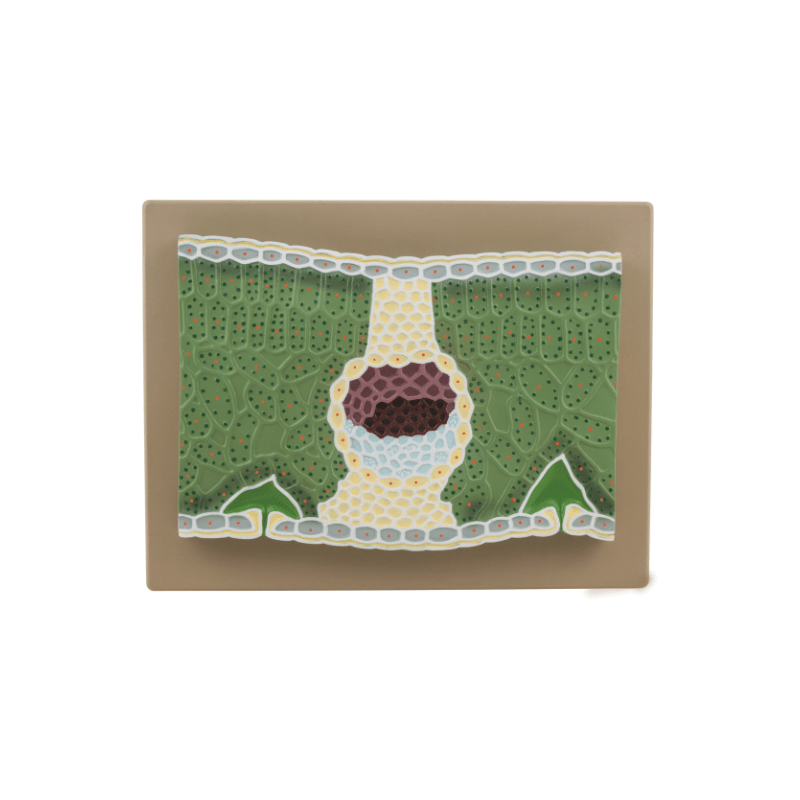
Dicot Leaf Model, on Base - Greatly Magnified
BM0020
Vendor: EISCO
Low stock! Only 2 left
Regular price
R 725.00
Sale price
R 725.00
Regular price
Unit price
per
Tax included.
Shipping calculated at checkout.
Couldn't load pickup availability
- Fast Nationwide Delivery
- 100% Quality Guaranteed
- Reliable & Secure Payments
Have a question about this product?
Send us a message and we'll get back to you.
This dicot leaf model is a 3D model of a greatly magnified dicot leaf section on a base, for learning about leaf structure and function. It shows the cuticle, epidermis, collenchyma, parenchyma (palisade and spongy), air spaces, chloroplasts, bundle sheath, sclerenchyma, xylem, phloem, guard cells and stomata. The structures are coloured and numbered, and a numbered key card is provided to identify and compare them.
- Cuticle: a protective, waxy layer on the leaf's surface
- Epidermis (upper and lower): the outer layer of cells, a protective barrier
- Hypodermis (collenchyma): a layer of supportive tissue just beneath the epidermis
- Palisade parenchyma: tightly packed cells containing many chloroplasts, responsible for most of the photosynthesis
- Spongy parenchyma: loosely packed cells with air spaces, for gas exchange in photosynthesis
- Air spaces: spaces between spongy parenchyma cells that allow gas to circulate
- Chloroplasts: organelles within parenchyma cells where photosynthesis takes place
- Bundle sheath: a layer of cells surrounding the vascular bundles that regulates the movement of substances
- Sclerenchyma: strong, supportive cells that give structure to the leaf
- Xylem: transports water and minerals from the roots to the leaf
- Phloem: transports sugars produced during photosynthesis to other parts of the plant
- Guard cells: specialized cells surrounding stomata that control their opening and closing
- Stomata: pores on the leaf surface that allow for gas exchange (CO2 in, O2 out) and transpiration
The details are hand-painted with eco-friendly paint.