Electricity kit (China)
XS-0028
Vendor: SmartLabs
Couldn't load pickup availability
- Fast Nationwide Delivery
- 100% Quality Guaranteed
- Reliable & Secure Payments
Have a question about this product?
Send us a message and we'll get back to you.
The XS-0028 Electrical Circuit Set (also known as the DIY Science Experiment Suit) is a popular educational starter kit designed for students to learn the fundamentals of school-level physics and electric circuits.
Kit Features and Application
- Educational Purpose: Ideal for learning basic electrical rules, building series and parallel circuits, and completing STEM or science fair projects.
- Safety First: Components are low-voltage and designed safely for children and beginners.
- Hands-on Learning: Helps improve critical thinking, problem-solving, and creativity through interactive experiment assembly.
- Product of China
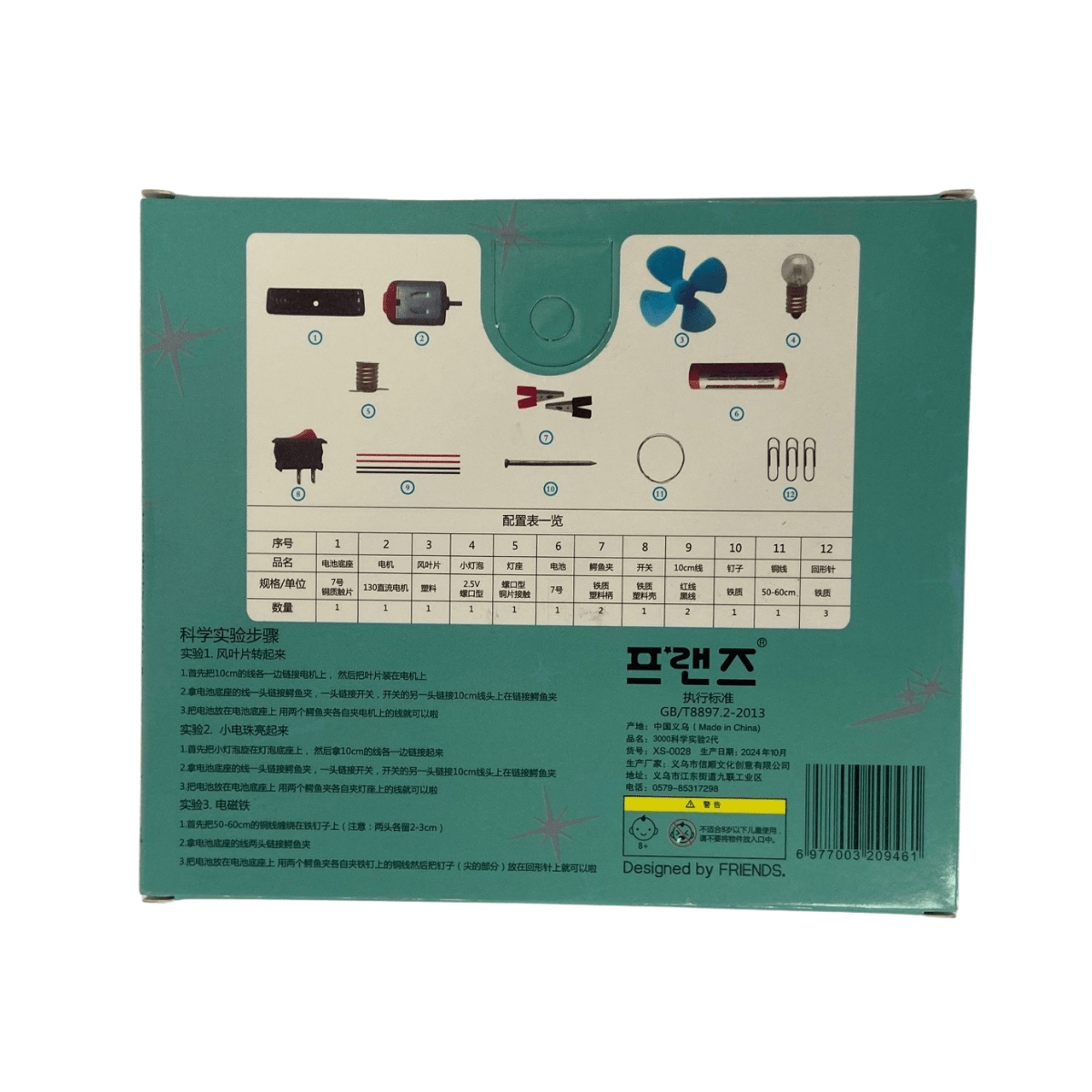
Kit Inventory List
- Battery Base Specification: AA size, copper contacts Quantity: 1
- Motor Specification: Type 130 DC motor Quantity: 1
- Fan Blade Specification: Plastic Quantity: 1
- Small Light Bulb Specification: 2.5V, screw-thread type Quantity: 1
- Bulb Holder Specification: Screw-thread type, copper contact plates Quantity: 1
- Battery Specification: AA size Quantity: 1
- Crocodile Clips Specification: Iron body, plastic handles Quantity: 2
- Switch Specification: Iron components, plastic housing Quantity: 1
- 10cm Wires (10cm) Specification: Red and black insulated wires Quantity: 2
- Nail Specification: Iron - used to build the electromagnet core Quantity: 1
- Copper Wire Specification: 50–60 cm length - used to wrap the nail Quantity: 1
- Paperclips Specification: Iron - used to test magnetism Quantity: 3
Science Experiment Steps
Experiment 1: Wind Leaf (Fan) Experiment
- Step 1: Connect the battery box, single-throw switch, and motor together using wires.
- Step 2: Attach the fan blade to the motor shaft. Turn on the switch to observe the fan blade rotation.
- Step 3: Reverse the positive and negative connections on the battery box. Turn on the switch again to observe the rotation direction.
Experiment 2: Small Light Bulb Experiment
- Step 4: Connect the battery box, single-throw switch, and bulb holder together using wires.
- Step 5: Install the small light bulb into the bulb holder. Close the switch to see the light bulb turn on.
- Step 6: Replace the single-throw switch with a double-throw switch to observe how the dual control functions.
Experiment 3: Electromagnet
- Step 7: Connect the battery box, switch, and electromagnet together using wires.
- Step 8: Place the compass or the iron powder box near the electromagnet. Turn on the power to observe the magnetic effect.
This specific electricity and magnetism kit aligns directly with several grade levels across the South African CAPS curriculum within the Natural Sciences & Technology and Technology learning areas:
1. Intermediate Phase: Grade 6 (Natural Sciences and Technology)
Term 3 Topic: Electric Circuits
- Application: This is the primary entry point for this kit. Grade 6 learners are introduced to circuit components, drawing circuit diagrams, and identifying conductors and insulators.
- Kit Use: Building simple closed circuits using the battery base, switch, wires, and light bulb to understand how current flows.
2. Senior Phase: Grade 8 & 9 (Natural Sciences)
Term 3 Topic: Energy and Change (Electrical Systems / Circuits)
- Application: At this stage, learners explore current electricity more deeply, including the effects of electric currents and basic circuit layouts.
- Kit Use:
- Grade 8: Investigating the three effects of an electric current (the heating/lighting effect with the bulb, the magnetic effect by using the copper wire and iron nail to create an electromagnet, and the mechanical/movement effect using the motor and fan).
- Grade 9: Introducing series vs. parallel circuits and exploring how cells act as energy systems.
3. Senior Phase: Grade 8 & 9 (Technology)
Term 4 (Grade 8) / General Project Work:
- Application: The Technology syllabus often requires learners to complete a Practical Assessment Task (PAT), such as designing an electromagnetic crane to sort scrap metal.
- Kit Use: The iron nail, copper coil, and paperclips are exactly what students need to prototype a working electromagnet experiment for their systems and control assessments.