Electrisity Kit Basic (China)
XS-0027
Vendor: SmartLabs
Couldn't load pickup availability
- Fast Nationwide Delivery
- 100% Quality Guaranteed
- Reliable & Secure Payments
Have a question about this product?
Send us a message and we'll get back to you.
Unlock the secrets of electricity with this complete, beginner-friendly STEM learning set. Designed for young scientists aged 8 and up, this hands-on kit includes everything needed to explore real-world physics. Watch their faces light up as they successfully wire a switch, connect a bulb, and harness magnetic forces using the included iron core, copper wire, and compass. It’s safe, intuitive, and the perfect screen-free activity to inspire the next generation of engineers and scientists!
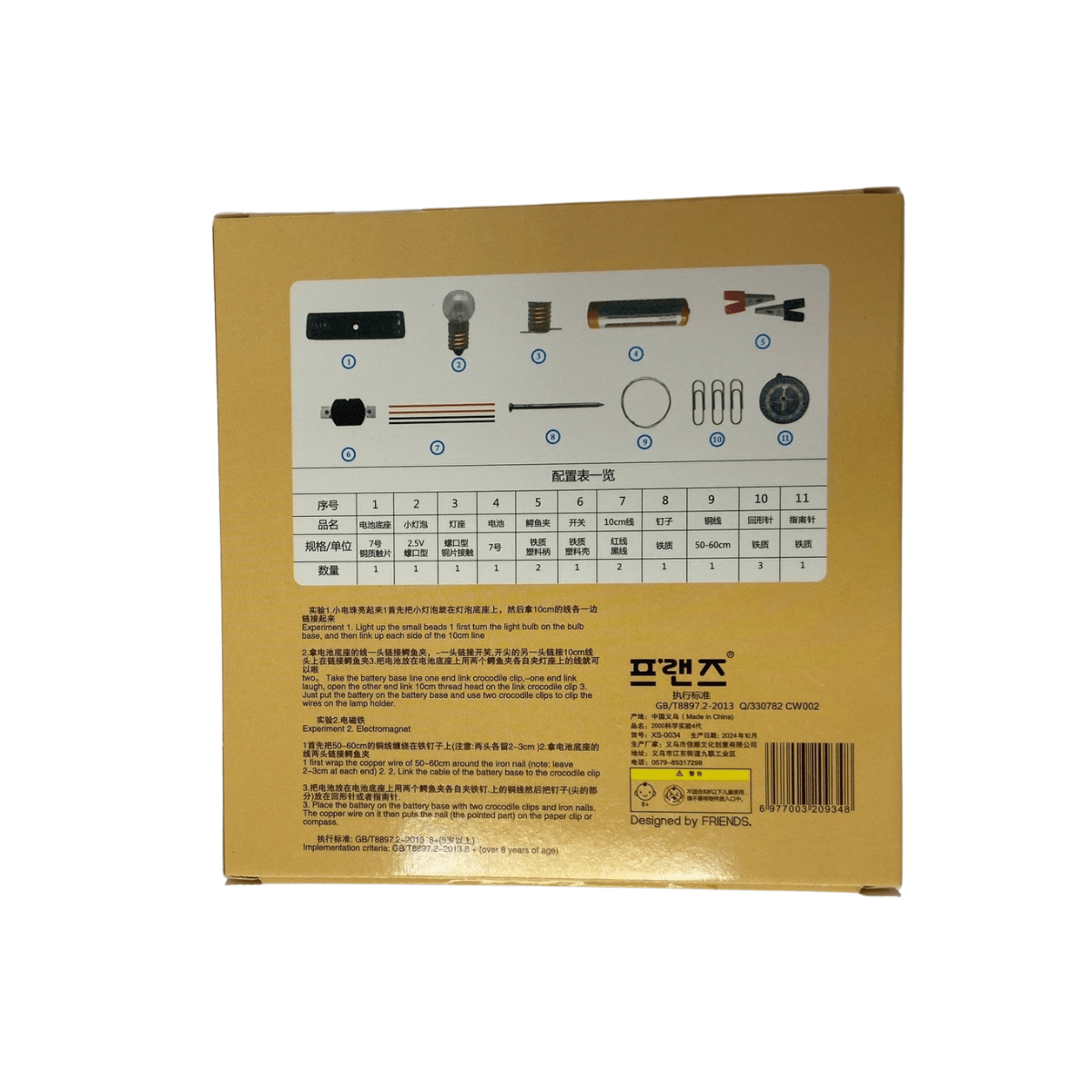
Kit Inventory List
- Battery Base Specification: AA size, copper contacts Quantity: 1
- Small Light Bulb Specification: 2.5V, screw-thread type Quantity: 1
- Bulb Holder Specification: Screw-thread type, copper contact plates Quantity: 1
- Battery Specification: AA size Quantity: 1
- Crocodile Clips Specification: Iron body, plastic handles Quantity: 2
- Switch Specification: Iron components, plastic housing Quantity: 1
- 10cm Wires (10cm) Specification: Red and black insulated wires Quantity: 2
- Nail Specification: Iron Quantity: 1
- Copper Wire Specification: 50–60 cm length Quantity: 1
- Paperclips Specification: Iron Quantity: 3
- Compass Specification: Iron casing/needle Quantity: 1
Experiment 1: Light up the Small Bulb
- Step 1: Screw the small light bulb (Item 2) securely into the bulb holder (Item 3).
- Step 2: Attach one end of a 10cm wire (Item 7) to one side of the bulb holder.
- Step 3: Attach the other end of that 10cm wire to one terminal of the switch (Item 6).
- Step 4: Connect a second 10cm wire from the remaining terminal of the switch to a crocodile clip (Item 5).
- Step 5: Place the AA battery (Item 4) into the battery base (Item 1).
- Step 6: Use the crocodile clips to connect the wire leads to the battery base contacts to complete the circuit.
- Step 7: Close the switch to turn the light bulb on.
Experiment 2: The Electromagnet
- Step 1: Wrap the 50–60cm copper wire (Item 9) tightly around the iron nail (Item 8).
- Step 2: Leave about 2–3 cm of loose copper wire extending from both ends of the nail.
- Step 3: Place the AAA battery into the battery base.
- Step 4: Attach crocodile clips to the loose ends of the copper wire protruding from the nail.
- Step 5: Connect these crocodile clips to the battery base contacts to power the electromagnet.
- Step 6: Test the magnetic effect by bringing the nail close to the paperclips (Item 10) or the compass (Item 11).
1. Intermediate Phase: Grade 6 (Natural Sciences and Technology)
- Term 3 Topic: Electric Circuits
- Application: This is the primary curriculum fit for the base components. Learners explore the concept of a complete, closed circuit.
- Kit Mapping: The battery base, switch, wires, and light bulb are exactly what is required to build a simple circuit. This helps learners identify components, trace current paths, and test materials for electrical conductivity.
2. Senior Phase: Grade 8 (Natural Sciences)
- Term 3 Topic: Energy and Change (Static and Current Electricity)
- Application: At this level, students investigate the real-world effects of an electric current.
- Kit Mapping:
- Lighting Effect: Explored using the small light bulb and base.
- Magnetic Effect: Taught by winding the copper wire around the iron nail to construct a functional electromagnet that can pick up the paperclips or deflect the compass needle.
3. Senior Phase: Grade 9 (Natural Sciences)
- Term 3 Topic: Energy and Change (Forces & Electric Circuits)
- Application: Grade 9 learners evaluate circuit layouts, series vs. parallel configurations, and field forces.
- Kit Mapping: The kit can be used to demonstrate magnetic fields using the compass or to outline how a switch safely acts as a control mechanism in series networks.
4. Senior Phase: Grade 8 & 9 (Technology)
- Term 4 (Grade 8) / Practical Assessment Tasks (PAT)
- Application: The Technology syllabus focuses heavily on Systems and Control (Electrical/Mechanical).
- Kit Mapping: Learners are often assessed on building an autonomous or manually switched prototype. The components in this kit provide the raw materials needed to construct simple, switch-controlled systems or electromagnetic lifting arms.