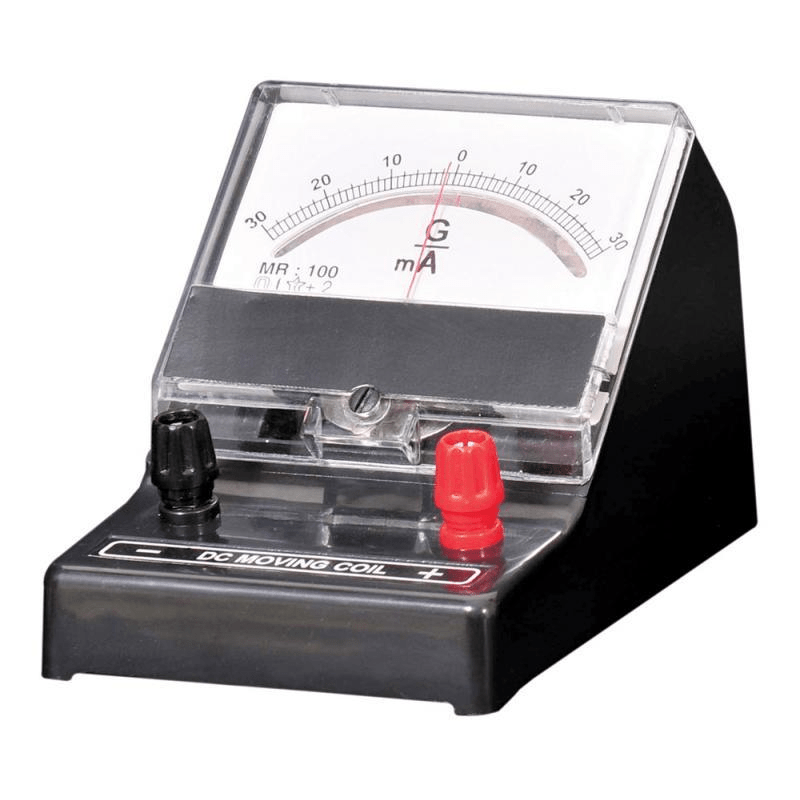
Galvanometer - DC Type
PH1084D
Vendor: EISCO
11 in stock
Regular price
R 350.00
Sale price
R 350.00
Regular price
Unit price
per
Tax included.
Shipping calculated at checkout.
Couldn't load pickup availability
- Fast Nationwide Delivery
- 100% Quality Guaranteed
- Reliable & Secure Payments
Have a question about this product?
Send us a message and we'll get back to you.
DC type galvanometers are sensitive electromechanical instruments used primarily to detect and measure extremely small electric currents in direct current (DC) circuits. They operate on the D'Arsonval/Weston moving coil principle, where current flowing through a coil in a permanent magnetic field generates a proportional torque that deflects a pointer.
Moving Coil Meters DC Type EDM-80 Square Clear acrylic front cover, fully enclosed economically priced and offer + 2.5% accuracy. Scale length 60 mm Overall size 125 x 80 x 80 mm with zero adjustment and connection terminals.
Applications in the Laboratory
- Null Detection: Their most frequent use is as a null indicator in bridge circuits, such as the Wheatstone Bridge or Kelvin Double Bridge, to identify the point of zero current.
- Potentiometer Experiments: Used to determine the balance point when measuring unknown electromotive forces (EMF).
- Conversion: While designed for small currents, a DC galvanometer can be converted into an ammeter by adding a parallel shunt resistor or into a voltmeter by adding a high series resistor.
Key Specifications
- Sensitivity: Typically measured in microamperes per division (µA/div). Common lab models like the EDM-80 offer sensitivities around 20 µA/div or 1 mV/div.
- Scale Design: Most laboratory galvanometers feature a centre-zero scale (e.g., 30-0-30 or 50-0-50), allowing them to indicate both the magnitude and the direction of current flow.
- Damping: To prevent the needle from oscillating excessively, these devices use eddy current damping (often an aluminium frame for the coil), ensuring the pointer settles quickly to its reading.
- Accuracy: Standard educational and industrial analog models typically offer an accuracy of ±2% to ±2.5% of full scale.