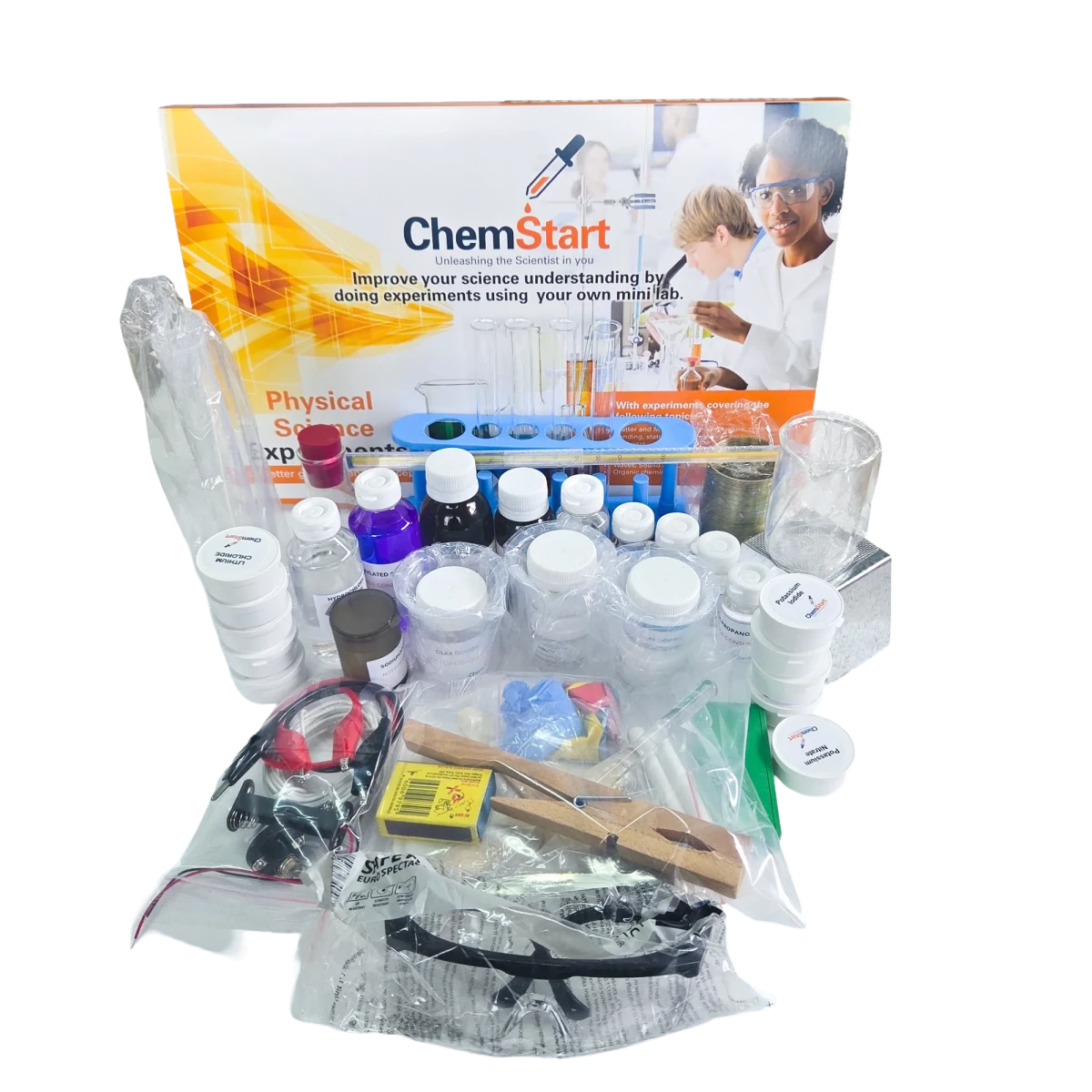
Grade 10 ChemStart Physical Science Kit
KIT-GRD10-CHEMSTART
Vendor: Nkazi Science
Couldn't load pickup availability
- Fast Nationwide Delivery
- 100% Quality Guaranteed
- Reliable & Secure Payments
Have a question about this product?
Send us a message and we'll get back to you.
This is a complete physical science kit built for Grade 10 CAPS learners: real lab chemicals, glassware and safety gear for hands-on experiments at home or in class, with a 63-page manual included as your step-by-step reference guide.
Chemicals in the kit
50ml acetic acid, 10g ammonium chloride, 10g barium chloride, 10g benzoic acid, 10g calcium chloride, 10g copper chloride, 10g copper sulphate, 50ml ethanol, 100ml dilute hydrochloric acid, 2g iodine crystals, 20ml isopropanol, 10g lead nitrate, 10g lithium chloride, 100ml methylated spirit, 20ml phenolphthalein, 10g potassium chloride, 5g potassium iodide, 10g potassium nitrate, 20ml of 0.1M silver nitrate, 20g sodium bicarbonate, 20g sodium carbonate, 25ml of 0.1M sodium chloride, 15g sodium hydroxide, 100ml dilute sodium hydroxide, 20g sodium sulphate, and 5g zinc granules.
Labware, equipment and safety gear
A glass beaker and three plastic beakers, a conical (Erlenmeyer) flask with stopper, a 50ml measuring cylinder, three test tubes with a rack and holder, a thermometer, a watch glass, a glass rod, two spatulas, a Pasteur pipette, a mini bi-pod stand with an alcohol burner, a pair of magnets, a light bulb and holder, a slinky spring, a silk cloth, a polystyrene cup with lid, chromatographic paper, graph paper, a 9V battery with an AA battery holder and alligator wires, copper wire, balloons, safety goggles and gloves.
The manual: your reference guide
The kit comes with a 63-page learner manual that acts as your reference guide. It opens with real lab safety rules and a laboratory apparatus guide before a single experiment starts, then walks through mixtures, chromatography, models of molecules, classification of matter, states of matter, flame tests, waves and sound, atoms and compounds, physical and chemical change, magnetism, electrostatics, electrical conductivity and reactions in solution: 14 topic chapters in total, each with the theory, the method, a results table and a worksheet.
Experiments you can run
Using the kit and manual together, a learner can separate a mixture of sand and sugar by dissolving, filtering and evaporating it, separate the dyes in Smarties or marking pen ink with paper chromatography, and build molecular models of water, chlorine, carbon dioxide and hydrogen sulphide out of dough and toothpicks.
They can test whether everyday substances conduct electricity with a simple light bulb and battery circuit, compare how fast a metal spoon and a plastic spoon heat up in boiling water, and test which classroom and household objects are magnetic.
They can watch copper sulphate diffuse through water, observe benzoic acid sublime straight from a solid to a gas, plot a full heating and cooling curve for water using ice and a Bunsen burner, and run a flame test on sodium, lithium, potassium, copper and barium chloride to see the different flame colours each metal produces.
They can send pulses down a slinky spring to observe impulse and interference, generate both transverse and longitudinal waves, build a working tin-can-and-string telephone, and measure the actual speed of sound in air using a loud sound, a stopwatch and a measured distance.
They can react zinc metal with dilute hydrochloric acid and pop-test the hydrogen gas produced, produce carbon dioxide from sodium bicarbonate and acetic acid to extinguish a candle flame, decompose hydrogen peroxide with a potassium iodide catalyst to relight a glowing splint, and weigh reactants and products before and after a reaction to demonstrate the law of conservation of matter.
They can map a bar magnet's field with iron filings and a compass, charge a plastic ruler by rubbing it on cloth to pick up small pieces of paper, test which solids and solutions conduct electricity, and identify chlorides, carbonates and sulphates in solution using silver nitrate and barium chloride.
A few household items you'll also need
Tap water for most experiments, ice and boiling water for the heating and cooling curve and thermal conductivity tests, an AA battery for the battery holder, a cotton cloth (or just your hair) to charge the plastic ruler in the electrostatics experiment, and a stopwatch or phone plus something that makes a loud, sharp sound for the speed of sound experiment outdoors.
Why it's worth it
A textbook can describe a chemical reaction. This kit lets a Grade 10 learner actually run it, with real chemicals and real glassware, under the same safety rules a school lab would use. Because Grade 10 covers the broadest spread of introductory topics in the CAPS Physical Sciences programme, the kit is built wide rather than deep: enough materials to get hands-on with both the chemistry and physics halves of the syllabus in one box.