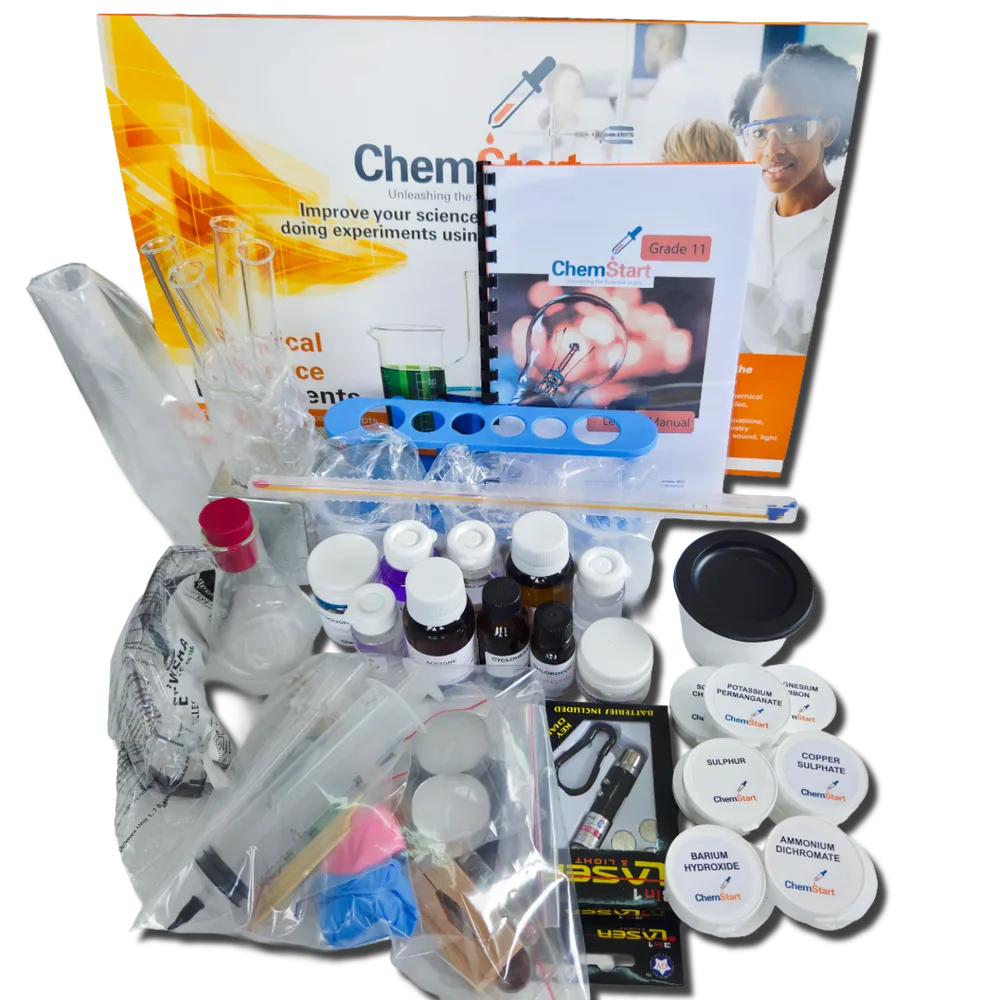
Grade 11 ChemStart Physical Science Kit
KIT-GRD11-CHEMSTART
Vendor: Nkazi Science
Couldn't load pickup availability
- Fast Nationwide Delivery
- 100% Quality Guaranteed
- Reliable & Secure Payments
Have a question about this product?
Send us a message and we'll get back to you.
This is a complete physical science kit built for Grade 11 CAPS learners: real lab chemicals, glassware and safety gear for hands-on experiments at home or in class, with a 59-page manual included as your step-by-step reference guide.
Chemicals in the kit
50ml aluminium, copper, steel and brass rod, 50ml acetic acid, 50ml acetone, 10g ammonium chloride, 10g ammonium dichromate, 10g barium hydroxide, 10g benzoic acid, 20ml chloroform, 20ml of 6% citric acid solution, 50ml copper sulphate, 10ml cyclohexane, 25ml ethanol, 2g glycerine, 1g iodine crystals, 2g lead nitrate, red and blue litmus paper, a strip of magnesium ribbon, 50ml methylated spirit, 20ml phenolphthalein, 5g potassium iodide, 10g potassium permanganate, 10g sodium bicarbonate, 10g sodium chloride, 25g sodium acetate, 50ml of 1M sodium hydroxide solution, and 10g sulphur.
Labware, equipment and safety gear
A glass beaker, three plastic beakers, a conical (Erlenmeyer) flask with stopper, a 50ml measuring cylinder, four test tubes with a rack and holder plus one large test tube, a thermometer, a watch glass, a stirring rod, a spatula, a Pasteur pipette and a serological pipette, capillary tubes, an alcohol burner and stand, a 50ml syringe with stopper, a marble ball, a laser pen, a rectangular glass prism (Perspex block), a 360-degree protractor sheet, graph paper, plasticine and beads with toothpicks for building molecular models, iron nails and sandpaper, steel wool, aluminium foil, string, a balloon, two candles, tweezers, safety glasses and gloves.
The manual: your reference guide
The kit comes with a 59-page learner manual that acts as your reference guide. It opens with real lab safety rules and a laboratory apparatus guide before a single experiment starts, then works through acceleration due to gravity, molecular shape, intermolecular forces, the chemistry of water, light, ideal gas laws, exothermic and endothermic reactions, acids and bases, and redox reactions: 9 topic chapters in total, each with the theory, the method, a results table and a worksheet.
Experiments you can run
Using the kit and manual together, a learner can build a ramp with a support and a smooth wooden plank, time a marble ball rolling down it with a stopwatch, and use the results to verify the value of the acceleration due to gravity from a graph of their own data.
They can build physical models of molecules like BeCl2, BCl3, CCl4, PF5 and SF6 using plasticine, toothpicks and beads to work out real VSEPR shapes, then do the same for molecules with lone pairs on the central atom like HCl, H2S and PCl3.
They can time how fast ethanol, water, nail polish remover and methylated spirits evaporate off a watch glass, compare surface tension by counting how many drops of water fit on a coin before it overflows, test the solubility of iodine and potassium permanganate in water, chloroform and ethanol, measure the boiling points of water, cooking oil and methylated spirits in a water bath, and compare how far water, oil and nail polish remover climb up a narrow capillary tube.
They can heat four different metal rods, steel, brass, copper and aluminium, coated with Vaseline over a Bunsen burner to see which one melts the wax first and rank the metals by how well they conduct heat.
They can measure the density of ice, chloroform and cyclohexane relative to water, dissolve salt, copper sulphate and headache powder in water to test it as a solvent, plot a solubility curve for potassium chloride, potassium nitrate and sodium acetate at different temperatures, and plot both a heating curve and a cooling curve for water using a thermometer and stopwatch.
They can prove light travels in straight lines using three punctured sheets of paper and a candle, refract light through glycerine and a stirring rod to make it disappear, track a laser beam bending through a rectangular glass block and back out into air, verify Snell's law by measuring angles of incidence and refraction with a protractor, and determine the critical angle of a Perspex block for total internal reflection.
They can demonstrate Boyle's law by pushing a lubricated golf ball into a syringe and watching the trapped air compress, and demonstrate Charles' law by watching a balloon shrink and expand as the trapped air is cooled in ice water and warmed over a Bunsen burner.
They can measure the temperature drop when citric acid reacts with sodium bicarbonate, the temperature change when barium hydroxide reacts with ammonium chloride, the heat given off when steel wool reacts with oxygen in vinegar, and the reaction between potassium permanganate and glycerine.
They can use litmus paper and phenolphthalein to test the acidity of vinegar, and make their own pH indicator by boiling red cabbage, then use it to test household liquids like apple juice, milk and bicarbonate of soda solution.
They can watch iron nails displace copper from a copper sulphate solution, react lead nitrate with potassium iodide to precipitate a bright yellow solid, decompose ammonium dichromate into a growing pile of green ash with a lit ethanol wick, and burn a strip of magnesium ribbon to see it react with oxygen in the air.
A few household items you'll also need
Tap water, ice and boiling water for the various heating, cooling and density experiments, a stopwatch or phone timer, a smooth plank at least 2m long and a few books to prop it up for the gravity experiment, a golf ball and dishwashing liquid for the gas law demonstrations, five identical coins and cooking oil for the intermolecular force experiments, and household liquids like apple juice, milk, vinegar, bicarbonate of soda, bleach and dishwashing detergent, plus a real red cabbage, for the acids and bases testing.
Why it's worth it
Where Grade 10 introduces the basics and Grade 12 drills matric exam topics, Grade 11 is built around real quantitative practical work: measuring a ramp and a stopwatch to verify the value of g, building an actual results table to test Boyle's and Charles' laws, plotting a heating curve for water from real thermometer readings. The equipment in this kit is chosen to produce real, usable data, not just something to watch happen.