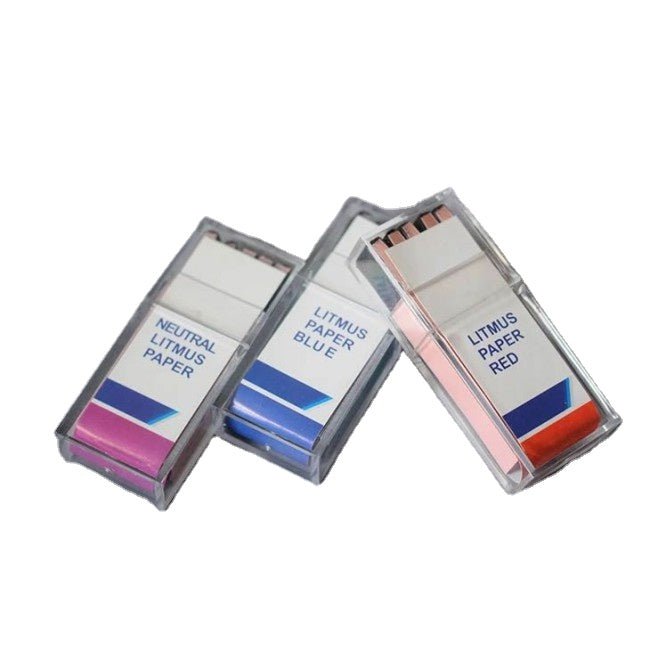
Litmus paper - 100 pages
C622D
Vendor: SmartLabs
Couldn't load pickup availability
- Fast Nationwide Delivery
- 100% Quality Guaranteed
- Reliable & Secure Payments
Have a question about this product?
Send us a message and we'll get back to you.
Red and blue litmus paper is the quickest way to tell whether a solution is an acid or a base. Blue litmus paper turns red in an acid, and red litmus paper turns blue in a base (alkali), with the colour change happening over pH 4.5-8.3 at 25°C (77°F). Neutral litmus paper is purple. Each pack holds 100 strips of dyed cellulose paper, and you can choose red, blue or neutral.
Package Includes:
- 100 pages (5 books, each with 20 pages) in a plastic container.
- Booklet format: small sheets bound together like a tiny notebook, where you tear out individual strips as needed.
- Slender cellulose fibre dyed paper strips (not reinforced).
Choose your colour:
- Blue Litmus Paper: primarily used to test for acids. Stays blue in neutral or alkaline solutions, but turns red/pink in acidic solutions below pH 4.5.
- Red Litmus Paper: primarily used to test for bases. Stays red in neutral or acidic environments, but turns blue in alkaline solutions above pH 8.3.
- Neutral (Purple) Litmus Paper: infused with a blended dye, giving an all-in-one test by turning red for acids and blue for bases, which is useful when you have no idea what the starting liquid is.
A note on what litmus paper can and can't detect: this is a general-purpose indicator, not designed for every possible substance. It won't show a clear colour change on liquids that sit very close to neutral (pH 7), even if that's genuinely the correct result rather than a fault with the paper.
Sunlight Liquid dishwashing liquid is a good example. Its pH sits between 5.0 and 7.0 depending on the exact formula variant (such as Lemon or Lime), meaning it ranges from slightly acidic to completely neutral. We don't recommend using it for a litmus demonstration, since the exact pH isn't known for each specific formulation and results will vary. If a particular batch sits at pH 7, red litmus paper simply won't turn blue. Because its pH is so close to neutral, or slightly acidic, it will generally turn blue litmus paper a very faint red/pink, or cause no major colour change at all if it lands exactly on 7.0. Red litmus paper will remain red. This is the correct, expected result, not a sign that the paper isn't working. If you want a visible reaction with something like Sunlight Liquid, a diluted sample dropped into purple red cabbage juice will turn a light violet or soft purple, showing its weak acidity/near-neutrality more clearly than litmus paper can.
Domestos and other bleach: testing thick bleach with litmus paper produces a distinctive reaction: the paper flashes blue and then turns completely white within seconds. The active ingredient in Domestos (sodium hypochlorite) destroys the plant-based pigments that give litmus paper its colour, breaking down the dye's chemical bonds and permanently bleaching both red and blue paper white. To see the pH before it bleaches: use universal indicator paper instead, which turns a deep violet or dark purple and resists the bleaching effect slightly longer than basic litmus paper, or dilute heavily (1 drop of Domestos into a large glass of water) so the bleaching power is weak enough for red litmus paper to turn blue and hold its colour for a bit longer before fading.
Other ways to test pH, alongside litmus paper
Every pack of pH paper comes with a printed colour-matching chart. After dipping a strip into your liquid for a few seconds, match its colour to the chart:
- Red / Dark Pink (pH 1-3): Strong Acids, e.g. battery acid, lemon juice, stomach acid
- Orange / Yellow (pH 4-6): Weak Acids, e.g. vinegar, coffee, milk
- Green (pH 7): Neutral, e.g. pure distilled water, saliva
- Blue (pH 8-11): Weak Bases, e.g. baking soda, sea water
- Purple / Violet (pH 12-14): Strong Bases, e.g. Domestos, bleach, drain cleaner, ammonia, tile cleaner
Universal indicator solution works on the same colour spectrum, but is a specialised laboratory liquid mixture made from a combination of several different pH dyes, rather than a paper strip.
Natural plant indicators (DIY): many plants contain water-soluble pigments that naturally behave as pH indicators, useful for a classroom demonstration alongside litmus paper.
- Turmeric Powder: a very good indicator for detecting strong bases. It's a bright yellow in neutral or acidic conditions, but changes to a deep dark red-brown when it touches an alkaline substance like laundry powder or soapy water.
- Butterfly Pea Flower Tea: naturally a deep blue colour. Adding an acid (like a squeeze of lemon juice) instantly turns it bright purple or hot pink.
- Red Cabbage or Black Bean Juice: both give a broad-range universal indicator. Boiling them creates a dark liquid that changes from red (acid) to purple (neutral) to green/yellow (base):
- Red / Dark Pink: Strong Acid (pH 1-3), e.g. lemon juice
- Light Pink / Violet: Weak Acid (pH 4-6), e.g. vinegar
- Purple: Neutral (pH 7), e.g. pure water
- Blue: Weak Base (pH 8-9), e.g. toothpaste water
- Green / Yellow-Green: Strong Base (pH 10-12), e.g. baking soda solution