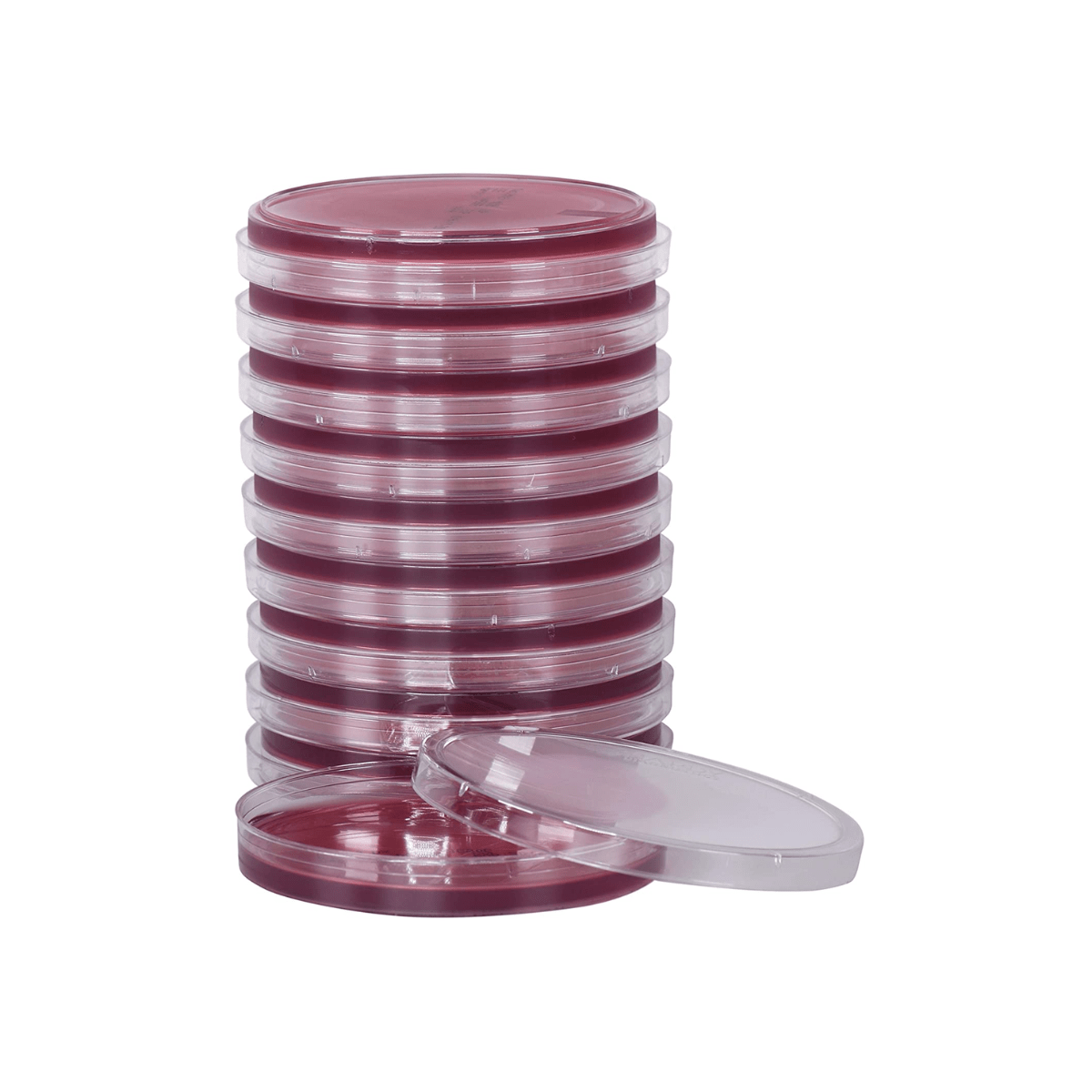
MacConkey Agar Plate - Pk 10
MM-M00400-PK10
Vendor: SmartLabs
Couldn't load pickup availability
- Fast Nationwide Delivery
- 100% Quality Guaranteed
- Reliable & Secure Payments
Have a question about this product?
Send us a message and we'll get back to you.
A MacConkey agar plate is a specialised solid growth medium used in microbiology to isolate and identify specific types of bacteria. Developed in the early 20th century by Alfred Theodore MacConkey, it does two jobs at once: it's both selective and differential.
In high school science, standard nutrient agar is usually used to grow anything and everything. MacConkey agar comes in at more advanced biology and environmental science levels, where it's used to teach students about metabolic pathways, classification and targeted testing.
Common ways it's used in student experiments:
1. Water Quality and Faecal Contamination Testing
Students sample water from different sources, for example a local pond, tap water, a puddle or a school drinking fountain.
- The goal: To test for coliforms (like E. coli), which point to sewage or animal waste contamination.
- The result: If pink colonies grow on the MacConkey plate, the water contains Gram-negative, lactose-fermenting bacteria, which alerts students to the presence of faecal coliforms.
2. The "Dirty Hands" & Hygiene Experiment
Students use a cotton swab to sample surfaces, or touch agar plates directly, to study the human microbiome and how well handwashing works.
- The goal: To tell skin bacteria apart from digestive (enteric) bacteria.
- The result: Rubbing dirty hands on a standard agar plate gives heavy bacterial growth, mostly Gram-positive skin bacteria. The same hands on a MacConkey plate usually give very little growth, which shows students that the microbes on our skin are very different from the enteric bacteria in our digestive tract.
3. Identifying Unknown Bacteria (The "Mystery Microbe")
Teachers often give students an unknown, mixed bacterial culture and ask them to separate and identify the species using several types of media.
- The goal: To learn how selective media speeds up diagnostic medicine.
- The result: Students streak the mixture onto a MacConkey plate. If it grows and turns bright pink, they can narrow their suspects down to a lactose-fermenting Gram-negative rod.
Storage for Prepared Plates (Petri Dishes)
If you have pre-poured plates or have just made a fresh batch, follow these steps:
- Temperature: Store them in a fridge at 2°C to 8°C, away from the freezer compartment. Never freeze agar plates, as freezing destroys the gel and makes it unusable.
- Position: Always store plates upside down (inverted, with the lid at the bottom). This stops condensation forming on the lid and dripping onto the agar, which can ruin bacterial streaks.
- Packaging: Keep the plates sealed in a plastic zip bag or airtight sleeve so the agar doesn't dry out, shrink or crack.
- Light protection: MacConkey agar contains neutral red dye and crystal violet, which are light-sensitive. Store the plates in the dark or in an opaque container.
- Shelf life: Plates prepared in-house usually last 2 to 4 weeks in the fridge.
Important High School Safety Note
MacConkey agar selects for Gram-negative enteric rods, a group that includes disease-causing bacteria like Salmonella, Shigella and pathogenic E. coli. For this reason, high school experiments should always keep the Petri dishes sealed once inoculated. Incubate the plates upside down so condensation doesn't smear the colonies, and the teacher should autoclave them or treat them with bleach before disposal.
DANGER: DO NOT USE ALCOHOL TO DISPOSE OF MACCONKEY AGAR PLATES
Using isopropyl alcohol or ethanol to destroy or dispose of cultured MacConkey agar plates is dangerous, doesn't work and creates immediate laboratory hazards.