Separating Funnel Borosilicate 3.3 Glass with PTFE Key - OMSONS
OM288P-1A19/26
Vendor: OMSONS
Suited For: Lab and Research
Country of Origin: India
This warranty does not cover: breakage caused by thermal shock (rapid heating or cooling); physical or mechanical damage, including drops, impacts, chips, and cracks from handling; damage from use outside the glassware's rated temperature, pressure, or chemical compatibility; damage from improper cleaning; normal wear such as scratching, staining, or discolouration; or unauthorised repair or modification.
To claim, contact SmartLabs within 30 days of purchase with proof of purchase and a description of the defect.
Couldn't load pickup availability
- Fast Nationwide Delivery
- 100% Quality Guaranteed
- Reliable & Secure Payments
Have a question about this product?
Send us a message and we'll get back to you.
A separating funnel, also known as a separation funnel, is a piece of laboratory glassware used to separate immiscible liquids, meaning liquids that do not mix, like oil and water. It is particularly useful in liquid-liquid extractions, where a mixture is separated into two distinct liquid phases based on density.
The liquids separate into layers, with the denser liquid settling at the bottom. A stopcock (a valve at the bottom) lets you drain the lower layer while the upper layer remains in the funnel. By carefully opening and closing the stopcock, the two liquids can be separated cleanly.
Key components
- Funnel body: the main container that holds the liquids.
- PTFE stopcock: a valve made from polytetrafluoroethylene (PTFE), also known as Teflon. PTFE provides excellent chemical resistance and durability, which makes it suitable for a wide range of reagents and liquids.
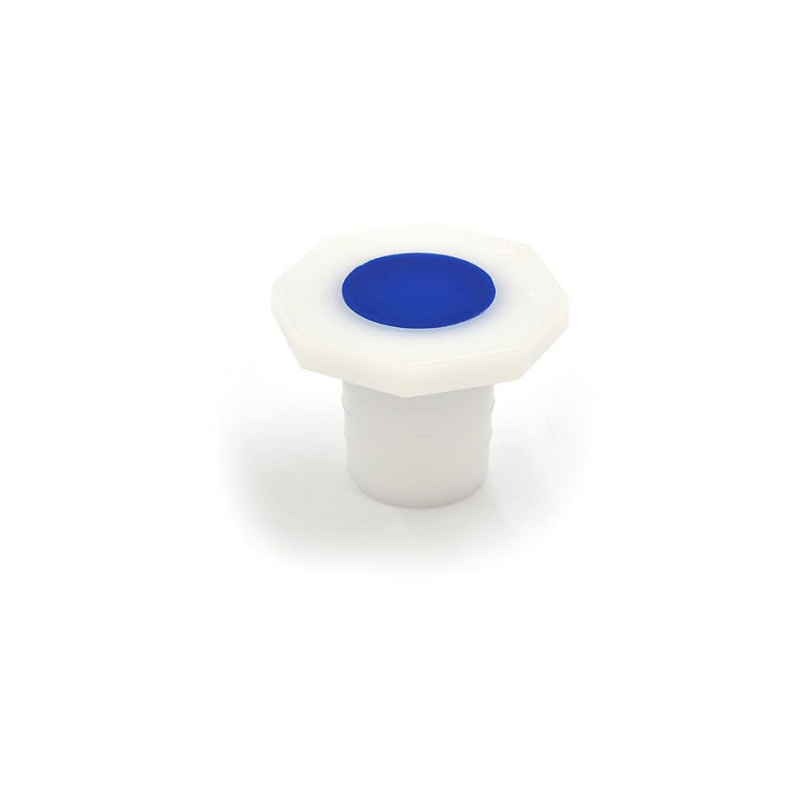
- Stopper: a polypropylene (PP) plug at the top that seals the funnel during shaking and mixing. PP is a thermoplastic polymer known for its strength, flexibility and resistance to many chemicals, acids and bases. It is also lightweight and can withstand high temperatures.
- Socket: the ground glass joint lets the funnel be sealed during use, preventing evaporation or leakage of liquids. The sizes are standardised, so a 24/29 joint on the funnel fits a 24/29 joint on a stopper, condenser or other glassware. The first number, 24, is the diameter of the larger end of the joint in millimetres. The second number, 29, is the length of the joint in millimetres.
- Drip tip: a narrow opening for liquids to exit the funnel, which gives a more controlled and directed flow and prevents splashing.
Specification
- Funnel body: conical
- Stopcock: PTFE key stopcock
- Stopper: PP (polypropylene) plastic stopper
- Material: borosilicate glass, for its chemical resistance and ability to withstand temperature changes
- Graduated: no
- Socket: 19/26 or 24/29 (select with the drop-down menu)
- Capacity: 125ml to 2000ml
- Drip tip: yes
- Brand: OMSONS
Specifications
Specifications
Delivery
Delivery
Warranty
Warranty
Our Promise
Our Promise